


Overview
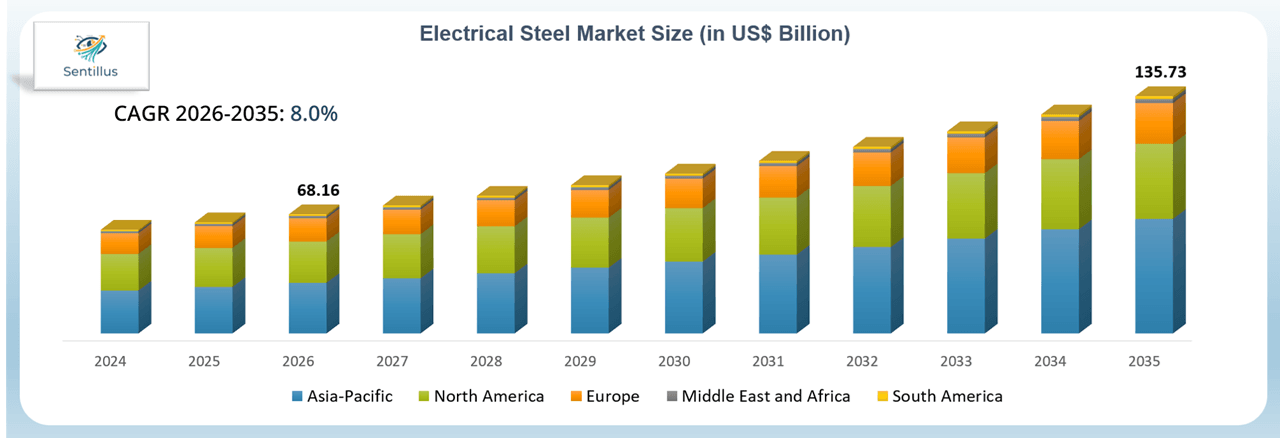
Electrical steel has turned out to be one of the most essential specialty metals that will enable the process of electrification globally. Renewable energy expansion, modernizing the electricity grid, and increased requirements for energy-efficient appliances continue to raise usage levels in utilities, industries, and transportation sectors. GOES remains the most preferred material for making transformers, whereas NGOES is extremely essential for the production of motors, generators, and rotating electrical appliances. In this scenario, the Global Electrical Steel Market reached 25,480.49 kilotons in 2026 and will reach 60,966.86 kilotons in 2035 at a CAGR of 10.2%.
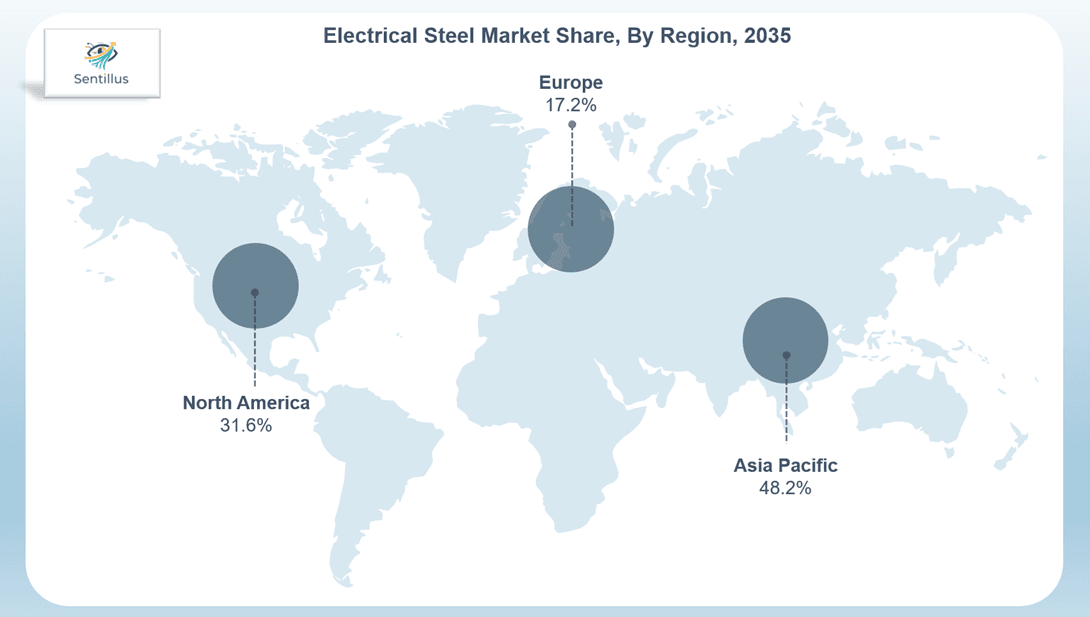
Regional demand shows varying levels of focus on investments. Asia-Pacific accounts for the highest demand because the region has both production of electrical equipment on a large scale along with expansion in transmission networks. The electrical steel demand volume stood at 14.95 Million Tons in 2026 and is expected to grow to 40.66 Million Tons by 2035, posting the highest regional CAGR of 11.8%. China continues leading the growth in regional demand, with India, Japan, and Southeast Asia contributing to the demand.
North America presents a different growth profile, where utilities are replacing aging transmission assets while manufacturers expand domestic production of transformers, motors and electric vehicles. Growing power consumption through artificial intelligence infrastructure, semiconductor fabrication facilities, and advanced manufacturing has led to rising interest in the stability of the power network as well. North America consumption amounts to 6.18 Million Tons in 2026 and is forecast to increase to 12.05 Million Tons by 2035, amounting to a CAGR of 7.7%.
European demand is less affected by growth in capacities and more affected by efficiency enhancement. Germany, France, and the United Kingdom are continuing to modernize their transmission networks, incorporate offshore wind generation, and implement stricter efficiency requirements for electrical equipment. The aforementioned expenditures helped to increase Europe electrical steel consumption to 3.66 Million Tons in 2026, with further estimated demand of 6.94 Million Tons by 2035 at a CAGR of 7.4%.
Market activity is growing in emerging economies. Middle East and Africa electrical steel market rose to 434 kilotons in 2026 and will reach 848 kilotons by 2035 due to investment in power generation systems and the use of renewable energy. South America recorded a rise to 256 kilotons in 2026 and is estimated to rise to 474 kilotons by 2035 due to upgrades in the transmission system and industrial activities.
China is the most influential country in demand terms globally. China electrical steel Consumption increased to 10.53 Million Tons in 2026 and is expected to grow to 30.31 Million Tons by 2035 due to the expansion of ultra-high voltage transmission lines, transformer production, renewable energy and electric vehicle production. USA electrical steel market will remain the second-largest market due to its continued investments in grid modernization and industrial electrification. India has remained one of the fastest-growing countries and consumption will increase from 1.48 Million Tons in 2026 to 4.33 Million Tons by 2035. Germany, Japan, France and United Kingdom have remained steady due to their advanced manufacturing and production of premium electrical equipment.
The demand dynamics have changed during recent years. The traditional power transmission projects constitute a big portion of demand for electrical steel, but there are other areas of growing demand in several different sectors. Large-scale solar parks, offshore wind energy projects, battery energy storage systems, and digital substations need highly efficient transformers made of GOES. Electric cars, robotic machines, semiconductor fabrication facilities, and large data center create demand for NGOES, which will be used in motors, generators, and automation machines.
On the other hand, the competition is also undergoing change. For the sake of offering better products in compliance with high efficiency standards, steel producers allocate resources to develop ultra-thin electrical steels, advanced magnetic materials, and eco-friendly manufacturing process. Companies that manage to provide lower core losses, higher magnetic permeability, and high-quality products are expected to succeed in the increasingly electrified world of the next decade.
Market Driver
Grid Investment Reshapes Global Demand for Transformer Electrical Steel
Electricity networks are entering a new investment cycle. Most of the current transmission infrastructure is outdated and does not suit the current electricity demands. Simultaneously, renewable energy sources are emerging faster than the traditional grids are capable of accommodating. Thus, utilities require new substations and transformers, and transmission lines have to be expanded before the installation of renewable energy sources for consumer use.
Transformer manufacturers sit at the center of this transition. Every new transformer requires grain-oriented electrical steel because magnetic efficiency directly affects energy losses throughout its operating life. Utilities increasingly evaluate equipment on lifetime efficiency rather than purchase price alone. Lower core losses translate into lower operating costs across large transmission networks. China remains the country with the greatest influence on international buying trends. The development of ultra-high-voltage transmission networks has led to constant demand for transformer electrical steel for the last few years. Renewable energy installations add another layer of consumption as new wind, solar and hydropower projects require additional transformer capacity before electricity enters the national grid.
Market conditions differ in the United States. Much of the current spending focuses on replacing aging transmission assets instead of building entirely new networks. Moreover, Utility companies are working on improving the power grids in order to be able to generate more electricity because of growing electricity demand for data centers, high-tech manufacturing plants, and electric vehicles. Contemporary transformers use high-quality electrical steel.
India is following a different path. Rapid urbanization, industrial expansion and nationwide transmission projects continue increasing transformer installations across generation, transmission and distribution networks. Green Energy Corridor projects have also accelerated procurement of electrical equipment designed for renewable energy integration. European demand reflects another trend. Grid operators in Germany, France and the United Kingdom are concentrating on efficiency improvements rather than large-scale expansion. Offshore wind projects, cross-border electricity trading and replacement of older substations continue supporting purchases of premium transformer materials.
Investment has become fast in several other emerging countries. Saudi Arabia and UAE are developing electricity networks, together with programs of industrial diversification. There have been investments in transmission network development in Indonesia and Vietnam in favor of their industrial growth. Investments are being made in Australia as renewable energy generation makes up a large part of their electricity system. The global demand for transformer steel no longer relies on one industry or one area alone. Network development, the integration of renewable energy sources, and the replacement of old equipment provide various sources of demand for the industry.
Market Opportunity
Hydrogen Investment Creates a New Growth Avenue for Electrical Steel Producers
Hydrogen projects are creating fresh opportunities for electrical steel manufacturers. Countries investing in low-carbon industrial development require new electrical infrastructure before hydrogen production reaches commercial scale. Electrolyzers, compressors, pumping systems and power distribution equipment all depend on transformers and electric motors manufactured with high-performance electrical steel. Unlike conventional power projects, hydrogen developments create demand across multiple stages of the value chain. Renewable power generation supplies electricity for electrolysis. Transmission networks deliver power to production facilities. Industrial equipment supports hydrogen compression, storage and transportation. Every stage increases the requirement for grain-oriented and non-grain-oriented electrical steel.
In terms of investment in hydrogen production on a grand scale, Saudi Arabia and UAE are amongst those with the highest levels. National energy policies keep encouraging the development of projects that involve the combination of renewable energy sources and hydrogen production. Australia is also similar, utilizes solar and wind power generation to create centers for hydrogen production to meet foreign demand. In Europe, the emphasis is made on industrial decarbonization. Investments in the development of hydrogen infrastructure to decrease emissions in the sectors of steel, chemicals and other heavy industry are continuing in Germany. Industrial equipment providers will profit from increased demand for efficient transformers, motors, and electrical power distribution systems. As well as Europe, Asia is increasing investments in hydrogen-related technologies. In China, hydrogen is used in heavy industry and transport sector, whereas in Japan and South Korea, fuel cells and mobility-related hydrogen are prioritized.
Segment Analysis
By Material Type: Grain-Oriented Electrical Steel Holds the Largest Share Through Its Essential Role in Power Networks
Power transmission is the most significant application of electrical steel, since grid networks require transformers for the transmission of electricity generated by power plants to industries, commercial establishments, and households. Grain-oriented electrical steels (GOES) are still preferred for transformer core usage because of their magnetic properties that help increase efficiency and reduce energy loss while operating continuously.
The consumption of grain-oriented electrical steels is characterized by investments for the long-term rather than market trends. The global demand for GOES stood at 3.8 Million Tons in 2026 and is expected to grow at a CAGR of 9.4% in 2026-2035. Utilities are replacing old transformers and building new ones for renewable energy, urban development, and increasing energy consumption. Every transmission corridor, substation and renewable power connection increases demand for transformer-grade electrical steel. Massive construction of ultra-high voltage transmission networks, use of renewables, and manufacture of transformers keep China’s demand higher than any other nation. Investments are made in generation, transmission, and distribution, creating stable demand in the electrical equipment value chain.
The United States and India take different paths of growth. Utilities in America work towards the renewal of old infrastructure and enhancing grid security. India is adding more transmission equipment due to increased demand for electricity in its industrial and urban regions. Both markets guarantee stable demand for high-end GOES. The European market focuses on efficiency gains. Transformer technology continues to be applied in Germany, France, UK, and Japan in an effort to increase efficiency and reduce operating losses. Demand for transformers is steady since utilities are keen on maximizing equipment longevity and reducing operating costs.
Emerging economies are also increasing transformer installations. Australia, Saudi Arabia, the United Arab Emirates, Indonesia and Vietnam continue investing in transmission infrastructure to support industrial expansion, renewable energy projects and growing electricity demand. Transformer applications will remain the largest source of electrical steel consumption because expansion of modern power networks depends on reliable and efficient magnetic materials. Few alternative materials match the performance required for high-capacity transmission equipment.
By Silicon Content: Medium Silicon Electrical Steel Leads Demand by Balancing Efficiency and Manufacturing Performance
Electrical steel manufacturers adjust silicon content to achieve the right balance between magnetic performance, mechanical strength and production cost. Medium silicon electrical steel has become the preferred choice because it delivers strong magnetic efficiency without creating significant challenges during rolling, punching and fabrication. Manufacturers across transformer, motor and generator industries therefore rely on this grade for a wide range of commercial applications.
Demand continues rising as industries seek higher equipment efficiency while maintaining competitive production costs. Transformer manufacturers require materials that minimize core losses, while motor producers prioritize magnetic performance without sacrificing manufacturing productivity. Medium silicon electrical steel satisfies both requirements, making it the largest segment within the market.
China still maintains its position as the top consumer owing to the country’s large-scale production of electrical equipment. The manufacture of transformers, industrial motors, household appliances, and electric cars contributes to the steady demand for medium silicon. The integrated logistics system also helps the manufacturers to maximize production to cater to the domestic market as well as export markets. Japan, South Korea, and Germany still focus on engineering applications. High-quality motors, industrial automation equipment, and advanced electrical systems need accurate magnetic properties, which are only provided by medium silicon electrical steel.
Further opportunities are being generated in India and Southeast Asia through their industrial growth. Rising investments in manufacturing, infrastructure development, and home appliances have increased the need for motors, pumps, compressors, and generators that use medium silicon steel. There has been an increase in the export of electrical goods from Vietnam, Thailand, and Indonesia. Innovation is also supporting long-term growth. Steel producers continue refining processing technologies to improve magnetic permeability while reducing manufacturing defects. These advancements enable equipment manufacturers to achieve higher efficiency without significantly increasing production costs. Medium silicon electrical steel will remain the dominant category because it offers the most practical combination of performance, manufacturability and commercial value across a broad range of electrical applications.
Geographical Analysis
United States Electrical Steel Market Analysis
In 2026, the United States consumed 5.5 Million tons of electrical steel which is anticipated to grow to 10.8 Million tons by 2035 registering a CAGR of 7.8%. Despite its relatively slow growth rate compared to Asia-Pacific, US is still regarded as one of the most strategic markets globally owing to the age of its transmission network, alongside the rapid rise of its artificial intelligence data centers and manufacturing investments.
Unlike China, where the demand is being driven by the establishing new transmission lines, US has invested a considerable amount in replacing aged ones. As per US Department of Energy (DoE), around 70% of the country’s transmission lines and large power transformers have reached more than 25 years of age and require immediate replacement. The utility companies are switching to lower loss designs in order to reduce the operational cost.
Federal legislation continues strengthening market fundamentals. The Infrastructure Investment and Jobs Act (IIJA) and the Inflation Reduction Act (IRA) together support billions of dollars in investment for transmission expansion, renewable energy integration, domestic transformer manufacturing and electric vehicle production. These initiatives are expected to increase procurement of premium GOES for power transformers and NGOES for electric traction motors over the forecast period.
Domestic supply remains relatively concentrated. Cleveland-Cliffs is the leading domestic producer of electrical steel following the acquisition of AK Steel, while imports from Japan and South Korea continue supplementing premium GOES requirements. Transformer manufacturers including Hitachi Energy, GE Vernova, Siemens Energy USA and Virginia Transformer remain among the largest consumers of electrical steel in the country.
Electric vehicles also represent an increasingly important growth segment. Expansion of domestic manufacturing by Tesla, General Motors, Ford and several international OEMs continue increasing demand for premium NGOES used in traction motors. Government incentives supporting local battery and motor production are expected to further strengthen domestic consumption. Future growth will increasingly depend on three structural drivers: modernization of aging transmission infrastructure, expansion of AI-related electricity demand and continued localization of advanced manufacturing. These factors are expected to maintain the United States as one of the highest-value electrical steel markets globally despite comparatively moderate volume growth.
Japan Electrical Steel Market Analysis
Japan consumed 341 Kilotons of electrical steel in 2026 and is forecast to reach 671 Kilotons by 2035, representing a CAGR of 7.8%. Market expansion is slower than most Asian economies because electricity infrastructure is already mature. Nevertheless, Japan remains one of the world’s most technologically advanced producers and consumers of premium electrical steel. Japan’s competitive edge comes from technology and not mass production. Manufacturers within Japan continue to be at the top of innovations on very low loss grain-oriented and non-grain oriented electrical steel, which is used in electric cars, robotics and industrial automation. Manufacturers like Nippon Steel and JFE Steel are still global standards on magnetic properties and high quality production of the products.
Government policies on energy efficiency are pushing the demand. Policies such as the Top Runner program by the Ministry of Economy, Trade and Industry (METI) push for higher efficiency standards of transformers and electric motors, thus encouraging the use of premium electrical steel that has lower core losses and better magnetic properties. Automotive manufacturing remains another major source of demand. Japan continues producing high-value hybrid and electric vehicles through manufacturers such as Toyota, Honda, Nissan and Mitsubishi Motors. Premium NGOES is widely used in traction motors, while advanced industrial motors support the country’s strong robotics and factory automation industries.
Transformer replacement rather than network expansion dominates utility investment. Regional utilities continue replacing aging transformers with higher-efficiency equipment capable of reducing transmission losses and improving grid resilience following increased renewable energy integration. Japan is also investing in hydrogen infrastructure, offshore wind development and semiconductor manufacturing, creating additional opportunities for electrical steel suppliers serving industrial electrical equipment. Although market growth is relatively modest, demand remains concentrated in premium products with significantly higher average selling prices than commodity electrical steel.
Long-term market leadership will depend on continuous innovation rather than production capacity. Japanese manufacturers are expected to remain among the world’s leading suppliers of high-performance electrical steel for advanced transformer and motor applications.
India Electrical Steel Market Analysis
India demand for Electrical Steel amounting to 1.48 Million tons in 2026 and is forecasted to touch 4.33 Million tons in 2035 at a CAGR of 12.7%. Fast paced industrialization, development of electricity transmission grid and uptake of electric vehicles make India one of the fastest growing markets for electrical steel in the world.
Demand for electricity is growing faster than that of many developed countries because of urbanization, industrialization, and increased household consumption. Some government schemes such as the Revamped Distribution Sector Scheme (RDSS), Green Energy Corridor, National Infrastructure Pipeline (NIP), and development of inter-state transmission grids are helping in purchase of transformers and electrical devices in the country. Renewable energy integration has become another important growth driver. India aims to achieve 500 GW of electricity generation from non-fossil sources by 2030, which will involve significant investment in substations, transmission corridors and balancing. The more renewables projects there are, the higher the demand will be for the grain-oriented electrical steel required in energy-efficient transformers.
The FAME II Scheme and the PM E-DRIVE programme have resulted in fast growth in electric mobility, and the manufacturing of electric vehicles like cars, buses and two wheelers is being promoted domestically. Companies like Tata Motors, Mahindra Electric, TVS Motor Company and Bajaj Auto are continuously demanding high quality NGOES.
India also has benefit of an expanding transformer manufacturing industry, with companies such as CG Power & Industrial Solutions, Bharat Heavy Electricals Limited (BHEL), Hitachi Energy India, Siemens India and Voltamp Transformers continuing to expand their manufacturing capacity to meet demand from domestic infrastructure projects and exports. Increasing localization of manufacturing of electrical equipment is anticipated to boost the demand for electrical steel from both domestic and international sources.
Local steel producers like Tata Steel, JSW Steel, SAIL and AM/NS India have been ramping up value added specialty steel manufacturing, while India still imports considerable quantities of premium grain oriented electrical steel to meet demand for transformer manufacturing from ultra-low loss material.
Long term growth potential for India is greater than that of most mature economies as investments are taking place concurrently in transmission infrastructure, renewable energy, manufacturing industry and electric mobility. Government backing of manufacturing as well as energy infrastructure in India is expected to fuel double digit demand growth of premium electrical steel applications over the next ten years.
Competitive Landscape
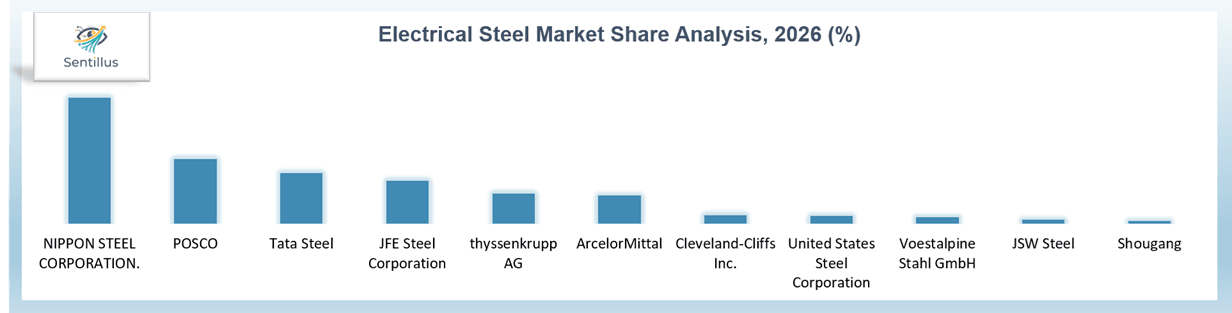
Competitive rivalry in the Electrical Steel market is restricted to only a few companies that possess state-of-the-art metallurgical abilities and proprietary technology for manufacturing. Manufacture of high-grade grain-oriented electrical steel (GOES) possess advanced technologies such as cold rolling, decarburization, secondary recrystallization and magnetic domain refining which not all manufacturers are capable of implementing. Therefore, competition is based primarily on the performance of the products and technology superiority rather than on capacity of production.
- China Baowu Steel Group represented by Baoshan Iron & Steel (Baosteel) is the largest manufacturer of electrical steel worldwide. The company benefits from strong domestic demand generated by State Grid Corporation of China, ultra-high-voltage (UHV) transmission projects and China’s expanding electric vehicle industry. Baowu has steadily increased production of both GOES and NGOES while investing in ultra-thin electrical steel for premium EV motors. Its vertically integrated operations and government-supported industrial ecosystem provide a significant cost advantage over many international competitors.
- Nippon Steel Corporation maintains one of the strongest technological positions in premium GOES. Rather than competing on production volume, the company focuses on high-efficiency transformer steel with extremely low core losses. Proprietary magnetic domain refinement technologies allow Nippon Steel to supply premium transformer manufacturers across Japan, Europe and North America where utilities prioritize lifetime efficiency over initial equipment cost. Continuous investment in research has enabled the company to retain pricing power despite increasing competition from Chinese suppliers.
- POSCO has established itself as one of the world’s leading suppliers of NGOES for electric vehicle applications. Long-term supply relationships with Hyundai Motor Group and several international automotive manufacturers position the company well as electric mobility expands. Recent investments in thinner NGOES grades and higher magnetic permeability products strengthen POSCO’s presence in premium traction motor applications where performance requirements continue becoming more stringent.
- JFE Steel Corporation competes through advanced product development rather than scale. The company supplies premium electrical steel for industrial motors, renewable energy generators and high-efficiency transformers. Development of thinner electrical steel gauges and improved insulation coatings has strengthened its position among manufacturers requiring high-performance magnetic materials for industrial automation and precision equipment.
European manufacturers continue serving high-value applications despite facing stronger cost competition from Asia. ArcelorMittal focuses on premium transformer steel and industrial electrical equipment while investing in lower-carbon steel production technologies to align with European sustainability targets. thyssenkrupp Steel Europe continues expanding high-grade NGOES production to support Europe’s growing electric vehicle supply chain. Voestalpine has a niche strategy in specialized electrical steel for automation in industry, rail, and precision engineering.
North America still relies heavily on imports of premium electrical steel, but its own capacity is slowly being increased. The Cleveland-Cliffs company, after its merger with AK Steel, has added strength to its portfolio of electrical steel by providing GOES and NGOES in transformers, motors, and vehicles. The government support in making transformers and maintaining a resilient supply chain is likely to be helpful for the company in establishing its competitive position in the future.
Every company has its own competitive strategies which is significantly different from each other. Chinese producers still focus on capacity building and low cost. Japanese producers have maintained their leadership due to high quality and innovative technologies. South Korean producers concentrate on application in electric cars, while European producers compete through sustainability and premium products, as well as engineering expertise. Leadership in the market in the future will not rely as much on capacity as on innovation, product quality and service to growing markets.
Key Companies
- thyssenkrupp AG
- POSCO
- ArcelorMittal
- NIPPON STEEL CORPORATION
- JFE Steel Corporation
- Tata Steel
- Voestalpine Stahl GmbH
- United States Steel Corporation
- Cleveland-Cliffs Inc.
- Shougang
- JSW Steel
BCG Matrix Analysis
Competitive positioning among the major electrical steel companies differs in terms of technological leadership, range of products and their penetration in high-growth applications and not total steel capacity.
| Quadrant | Companies | Strategic Position |
| Stars | China Baowu, Nippon Steel, POSCO | Companies are characterized by high market share and presence in high-growth industries like ultra-high voltage transmission, electric vehicles and renewable energy. Continuous investment in premium GOES and NGOES technologies supports long-term leadership. |
| Cash Cows | JFE Steel, Cleveland-Cliffs, ArcelorMittal | Established customer relationships, stable transformer and industrial motor businesses and proven manufacturing capabilities generate consistent revenue despite comparatively moderate growth rates. |
| Question Marks | thyssenkrupp Steel Europe, Voestalpine, NLMK | Investments in premium electrical steel continue increasing, particularly for electric mobility and industrial automation. Market share remains smaller than industry leaders, yet future growth potential remains significant if expansion strategies succeed. |
| Dogs | Regional manufacturers producing conventional low-grade CRGO and NGOES products | Regional manufacturers producing conventional low-grade CRGO and NGOES products. Companies serving mature commodity markets with limited investment in advanced magnetic materials face increasing competitive pressure as customers transition toward premium high-efficiency electrical steel. |
The competitive leadership is now driven by innovation and not only scale. Companies with strong presence in electric mobility, advanced transformers and high-end industrial applications strengthen their competitive position, whereas those engaged solely in the production of commodity electrical steel will grow less dynamically.
Regulatory Landscape
The energy efficiency requirements in respect of transformers and electric motors have become increasingly stringent in leading countries, resulting in the use of grain oriented electrical steel (GOES) with lesser core losses and non-grain oriented electrical steel (NGOES) with better magnetic efficiency. The adherence to such norms has been determining the buying choices of the consumers in the industry.
European Union
The European Union has remained the leader in global efficiency regulations through the Commission Regulation (EU) 2019/1783 that amended the Ecodesign requirements for power transformers, set out in the Commission Regulation (EU) No. 548/2014. The regulation has set Tier 2 efficiency requirements since July 1, 2021, decreasing the maximum allowed values of no-load and load losses for medium and large power transformers.
The transformer suppliers for European utilities use high-permeability electrical steels from companies as Nippon Steel, JFE Steel, thyssenkrupp Steel Europe and ArcelorMittal due to the inability of standard CRGO to meet modern requirements.
The motor efficiency regulations through the Commission Regulation (EU) 2019/1781 have promoted even more the introduction of NGOES with IE3 and IE4 efficiency class for a wide range of industrial electric motors. Manufacturers producing motors for industrial automation, HVAC equipment and electric mobility increasingly require thinner NGOES grades with superior magnetic properties.
United States
The United States regulates transformer efficiency through the U.S. Department of Energy (DOE) Energy Conservation Standards (10 CFR Part 431) covering distribution transformers. Updated standards require manufacturers to reduce energy losses throughout transformer operating life, encouraging wider adoption of high-grade GOES.
Motor efficiency is governed through the Energy Independence and Security Act (EISA 2007) together with DOE efficiency regulations. These standards require premium-efficiency motors across industrial applications, increasing demand for NGOES with lower iron losses.
Recent federal investment programs have further strengthened demand. The IIJA has provided substantial funding for the modernization of the grid, construction of new transmission lines, and substation improvements, while the IRA focuses on developing renewable energy sources, domestic manufacturing of products, and electric vehicles. All of this is leading to an increased demand for transformers, generators, and traction motors made from high-grade electrical steel.
Domestic suppliers including Cleveland-Cliffs are expected to benefit as utilities and transformer manufacturers seek to strengthen North American supply chains for critical electrical materials.
China
China has developed one of the world’s most comprehensive regulatory frameworks supporting high-efficiency electrical equipment. National standards like GB 20052 (Minimum Allowable Values of Energy Efficiency and Energy Efficiency Grades for Power Transformers) and GB 30253 (Minimum Allowable Values of Energy Efficiency for Permanent Magnet Motors) have higher efficiency requirements for transformers and electric motors.
Policy pursued by the government in line with the 14th Five-Year Plan (2021-2025) focuses on grid modernization, energy from renewables, advanced manufacturing, and production of electric vehicles.
India
India is strengthening energy efficiency through multiple regulatory initiatives led by the Bureau of Energy Efficiency (BEE) under the Energy Conservation Act, 2001. BEE’s Standards & Labeling Programme encourages adoption of high-efficiency transformers, motors and industrial electrical equipment, increasing demand for premium electrical steel.
Government programs including the Revamped Distribution Sector Scheme (RDSS) and Green Energy Corridor Programme continue supporting transmission expansion, smart substations and renewable energy integration. These projects require transformers with lower operating losses, encouraging procurement of premium GOES.
India’s National Electric Mobility Mission Plan (NEMMP) and the FAME II Scheme have also accelerated domestic electric vehicle manufacturing, creating additional demand for NGOES used in traction motors. Growing localization of transformer manufacturing is expected to create opportunities for both domestic steel producers and international suppliers serving the Indian market.
Japan
Japan maintains some of the world’s highest efficiency standards through the Top Runner Program, administered by the Ministry of Economy, Trade and Industry (METI). The program establishes progressively higher efficiency benchmarks for transformers, motors and electrical equipment by using the most energy-efficient commercially available products as the performance benchmark.
The requirements will result in large-scale use of ultra-low loss GOES and NGOES of superior quality in manufacturing of transformers as well as industrial and automotive applications. The Japanese steel manufacturers such as Nippon Steel and JFE Steel have been using their long experience in applying metallurgical techniques to produce electrical steels that meet strict standards.
South Korea
South Korea promotes high-efficiency electrical equipment through the Energy Use Rationalization Act and the High-Efficiency Appliance Certification Program administered by the Korea Energy Agency. National industrial policy strongly supports electric vehicles, battery manufacturing and semiconductor production. Expansion of these industries has increased demand for high-performance NGOES supplied by POSCO, particularly for traction motors and advanced industrial equipment.
Regulatory Outlook
Future regulations are expected to pay less attention to compliance with minimum requirements and concentrate more on energy and carbon savings along the entire life-cycle of a product. Regulatory authorities in Europe, North America, and Asia are increasingly demanding higher efficiency from transformers, electric motors, and industrial electrical equipment and supporting lower emission processes in steel making. Companies able to manufacture low-loss GOES and NGOES and lower carbon electrical steel are likely to gain from that trend.
Recent Developments
February 2026: Nippon Steel Corporation increased its production capacity of quality non-grain oriented electrical steel due to rising demand by the EV industry and high-efficiency industrial motor applications.
December 2025: POSCO corporation made more investments into developing modern technologies of electrical steel production that would enhance magnetic properties of their products as well as enable their use in the latest automotive and renewable energy applications.
October 2025: Baowu Group hastened the development of high-quality grain-oriented electrical steel for ultra-high-voltage power lines because China was further developing its power infrastructure.
August 2025: JFE Steel company launched new electrical steel products with improved magnetic properties to minimize core losses in distribution transformers.
June 2025: ArcelorMittal diversified its electrical steel products range through making investments into technologies of sustainable steel production.
Future Outlook
The electrical steel market is entering a fundamentally different growth cycle than the one experienced over the past two decades. Historically, demand was closely tied to expansion of electricity transmission networks and replacement of aging transformers. The future will see growth through a wider range of industries, with less reliance on one specific application or region.
Transformers will continue to drive the industry especially with upgrades of the grid and incorporation of renewable energy into the grid system. However, electric mobility is expected to narrow the gap between transformer applications and motor applications. Growth in battery electric vehicles, hybrid vehicles, rail electrification and industrial automation will significantly increase consumption of premium NGOES throughout the forecast period.
Artificial intelligence is likely to emerge as another structural demand driver. Construction of hyperscale data centers, semiconductor fabrication plants and cloud computing infrastructure requires large numbers of high-efficiency transformers, backup generators and industrial cooling systems. Although AI currently represents a relatively small share of electrical steel consumption, electricity demand associated with digital infrastructure is expected to accelerate rapidly over the next decade.
China is expected to retain its leadership in the market based on production scale and manufacturing, but Japan would remain a leader based on metallurgical technology and higher quality products. South Korea would be ideally suited for capitalizing on the growing production of electric cars, while Europe would gain competitiveness based on innovation focused on sustainability and low carbon electrical steel. North America would be expected to rely less on imports with increasing investments in transformer manufacturing and materials production.
Innovation would increasingly become the driver of market leadership. Those manufacturers that can produce ultra-thin NGOES, high permeability GOES and low carbon electrical steel would be more likely to gain market share in the markets of renewable energy, electric mobility and digital infrastructure. Companies that have been focusing solely on producing electrical steel would be unlikely to see significant growth.
Market Scope
| Metrics | 2026 Market Size (Value) | 2026 Market Size (Value) | Value CAGR (2026-2035) | Largest Material Type | Fastest Growing Application |
| Details | US$ 68.16 Billion | US$ 135.73 Billion | 8.0% | Non-Grain-Oriented with 72.5% Market Share | Motors, 8.6% CAGR
|
| Segment | Material Type | Silicon Content | Product Form | Manufacturing Technology |
| Details | Grain-Oriented Non-Grain-Oriented | Low Silicon (<2%) Medium Silicon (2-3%) High Silicon (3-6.5%) | Sheets Coils Strips Others | Cold Rolled Hot Rolled |
| Segment | Power Rating | Thickness | Application | End-User |
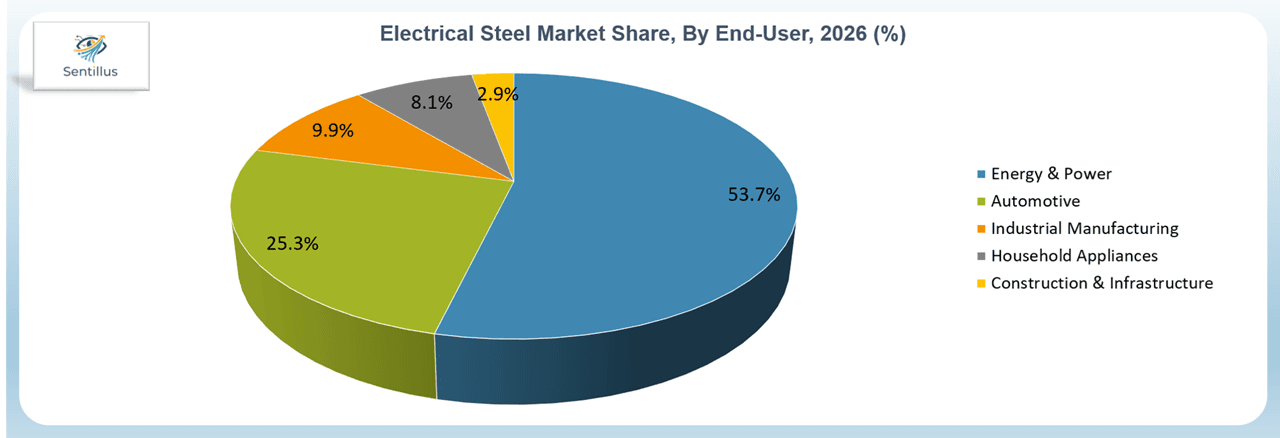
| Details | Low Power (<1 kW) Medium Power (1 kW-100 kW) High Power (>100 kW) | Thick Gauge (>0.5 mm) Medium Gauge (0.3-0.5 mm) Thin Gauge (0.2-0.3 mm) Ultra-Thin (<0.2 mm) | Transformers Motors Generators Inductors & Reactors | Energy & Power Automotive Industrial Manufacturing Household Appliances Construction & Infrastructure |
Who Should Buy This Report
Electrical steel market intelligence provides strategic value for organizations involved in manufacturing, investment, supply chain management and industrial planning. Decision-makers seeking long-term growth opportunities can utilize the report to evaluate emerging demand centers, technology trends and competitive positioning across major regional markets.
Primary beneficiaries include:
- Electrical steel manufacturers evaluating capacity expansion and product portfolio strategies.
- Transformer manufacturers assessing future procurement trends and utility investment opportunities.
- Electric motor manufacturers developing high-efficiency industrial and automotive products.
- Electric vehicle OEMs and Tier-1 suppliers planning material sourcing strategies.
- Renewable energy equipment manufacturers supporting wind, solar and energy storage projects.
- Industrial automation companies supplying robotics, manufacturing equipment and smart factory solutions.
- Utility companies planning transformer replacement programs and transmission infrastructure investments.
- Engineering, Procurement and Construction (EPC) contractors executing power infrastructure projects.
- Raw material suppliers supporting specialty steel manufacturing.
- Institutional investors, private equity firms and strategic investors evaluating industrial materials opportunities.
- Government agencies developing manufacturing and energy transition policies.
- Consulting firms supporting market entry, investment feasibility and competitive benchmarking assignments.
- Financial institutions conducting industry due diligence before project financing.
- Research organizations monitoring technological developments within advanced materials and electrification.
Comprehensive market intelligence enables stakeholders to identify investment priorities, evaluate competitive risks, strengthen procurement strategies and anticipate structural changes influencing long-term industry development.
Frequently Asked Questions
Why Choose Sentillus?
Decision-Oriented Research
Sentillus delivers research designed for business decisions rather than information collection. Every study combines industry expertise, strategic analysis and practical market intelligence supporting investment, expansion and competitive planning.
Reliable Primary and Secondary Validation
Research integrates interviews with industry participants including manufacturers/service providers, dealers/distributors/agents/3rd-party suppliers and customers/consumers, public company disclosures, government publications, trade associations, consortiums, paid databases and verified industrial databases to improve analytical reliability.
Consultant-Level Industry Analysis
Every report explains why market changes occur, how competitive dynamics evolve and which developments create future business opportunities rather than simply presenting historical information.
Customized Business Intelligence
Clients receive research tailored to strategic priorities including market entry assessment, competitive benchmarking, supplier evaluation, investment opportunity analysis, pricing assessment and technology landscape studies.
Practical Competitive Insights
Competitive evaluation extends beyond company profiles by examining manufacturing capabilities, expansion strategies, product positioning, innovation priorities and strategic partnerships influencing industry leadership.
Comprehensive Regional Coverage
Country-level analysis evaluates industrial development, manufacturing capacity, production & yield, infrastructure investment, regulatory changes, trade activity and demand outlook across major global markets.
Continuous Research Support
Consultant assistance helps clients interpret findings, clarify market developments and understand industry trends after report delivery, ensuring greater value throughout the decision-making process.
High-Quality Research Standards
Every report follows a structured research methodology emphasizing data accuracy, logical analysis, clear business communication and actionable recommendations suitable for executives, investors and strategy planning teams.