
 Overview
 Overview
Frozen food no longer competes with fresh food on shelf life alone. Commercial buying patterns have changed to favor reliable supply, stock management, and product quality standards, and thus the frozen foods have become an important component of the buying patterns of retail merchandising and institutional food service providers. Global frozen food market revenue in 2026 stood at USD 467.09 billion and is expected to grow to USD 797.75 billion in 2035, representing a CAGR of 6.1%. Product innovation contributes to value creation although the industry’s commercial foundation continues to depend on refrigerated logistics, processing capacity and retailer freezer space.
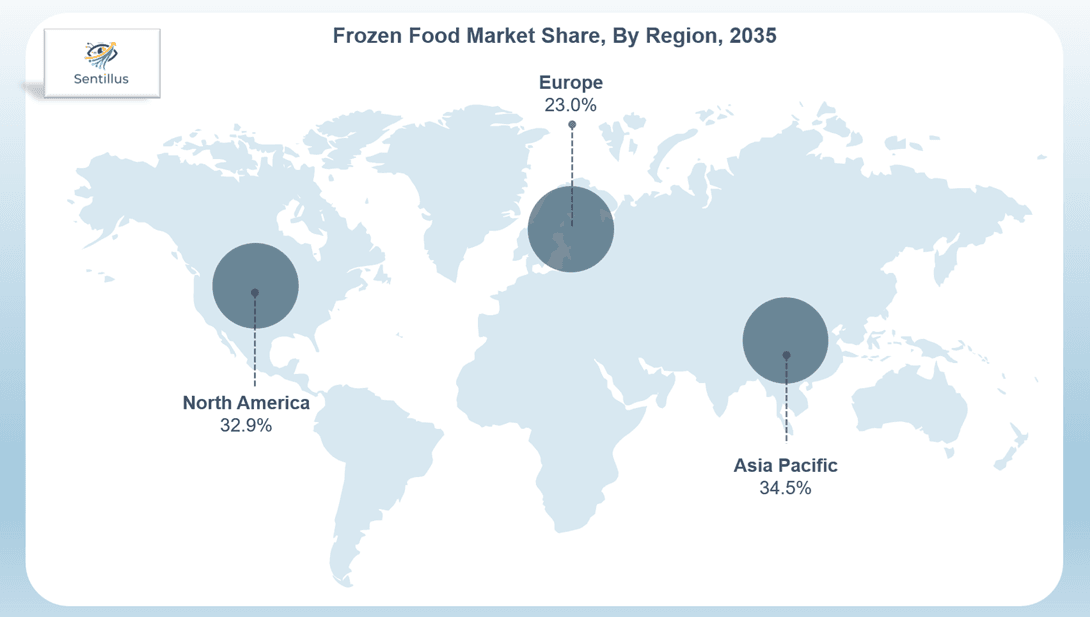
Regional performance demonstrates varied levels of industry development instead of any universal growth trend. In Europe, USD 116.72 billion worth of frozen food was consumed in 2026, which remains the biggest part of the regional market due to manufacturing activities in a well-developed processing infrastructure, supported by a dense network of supermarkets and effective cross-border distribution. Additional earnings come not from the quick household penetration but from high-end ready meals, bakery items and seafood. Asia-Pacific provides nearly the opposite business environment, its revenue amounted to USD 131.25 billion in 2026 and will amount to USD 274.88 billion by 2035, which will be the fastest regional growth at 8.3%. The development of processing plants, refrigerated warehouses and organized retail enables domestic manufacturing companies to meet the demand that used to come through the import channel.
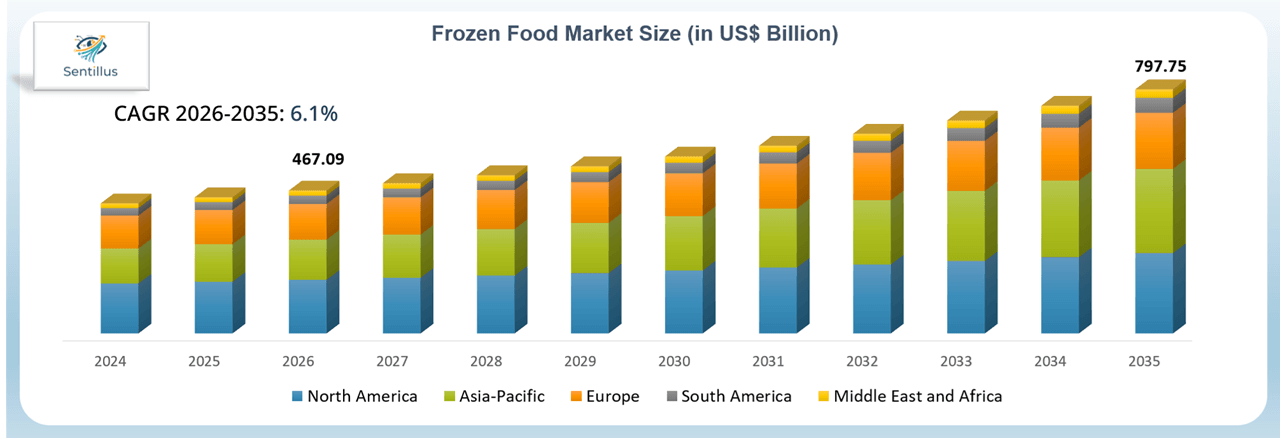
North America frozen food market reached USD 175.10 billion in 2026 and is forecast to amount to USD 262.61 billion by 2035. Stable institutional procurement distinguishes the region from many other markets. Restaurants, healthcare providers, contract caterers and quick-service restaurant chains purchase frozen products under recurring supply contracts, reducing fluctuations normally associated with household food spending. Retail sales remain strong, although foodservice purchasing creates a dependable revenue base that supports long-term manufacturing utilization.
US was a major frozen food consumer, accounting for USD 118.55 billion in 2026 as a result of highly developed integration between food processing capacity, its chilled delivery and branded food production. The leading European food producer, Germany accounted for the highest purchases through its well-developed production facilities of food and its distribution, whereas France and UK maintained their steady sales through ready meals, baked goods, frozen sprouts, frozen peas and frozen vegetables. In Latin America, the key expanding country was Brazil whose market grew up from USD 18.82 billion in 2026 to USD 32.59 billion in 2035 in terms of steady investments in food production and expansion of supermarket chains and consumer demand for convenient food packaging.
Commercial demand is largely determined by the purchasing method since institutional purchasing dominates in view of high attention paid to procurement effectiveness and consistent delivery. Household demand stays the same and concentrates in the sphere of supermarkets and online groceries where frozen food is expanded in order to increase the basket price. Frozen bakery products and snacks generate the highest product revenue, reflecting frequent purchase behavior, broad merchandising opportunities and continuous product renewal by established manufacturers.
Market Driver
Expansion of Organized Cold-Chain Infrastructure and Modern Food Retail Networks Sustains Commercial Consumption of Frozen Food
Development in the capacity of temperature-controlled facilities as well as refrigerated distribution networks has been fundamental in reinforcing commercial consumption of frozen foods as it improves the accessibility of products in both retail and foodservice networks. Cold chain technology enhances product consistency from manufacturing facilities through distribution centers up to retailers, allowing manufacturers to introduce frozen fruits, frozen vegetables, frozen meats, frozen shrimp, baked goods, snacks and ready-to-eat meals without risking the quality and food safety of their products. Meanwhile, organized retailers increased their capacity of frozen sections of stores, making it possible for premium and added-value frozen food products to have greater visibility in the marketplace than conventional frozen foods.
Commercial development of manufacturing and cold chain infrastructure plays an important role in reinforcing market expansion. McCain Foods revealed the company’s investment in a new manufacturing facility that produces potato flakes and potato fries in Madhya Pradesh, India; thereby helping enhance manufacturing capacities at home while promoting localizing manufacturing of frozen food products in the rapidly growing market for consumers in the world. Additionally, Nomad Foods has developed manufacturing capacities by investing in potato waffles manufacturing facility located in Lowestoft manufacturing facility in United Kingdom. Capacity expansion projects of this nature improve supply reliability, shorten distribution lead times and support broader product availability across organized retail networks.
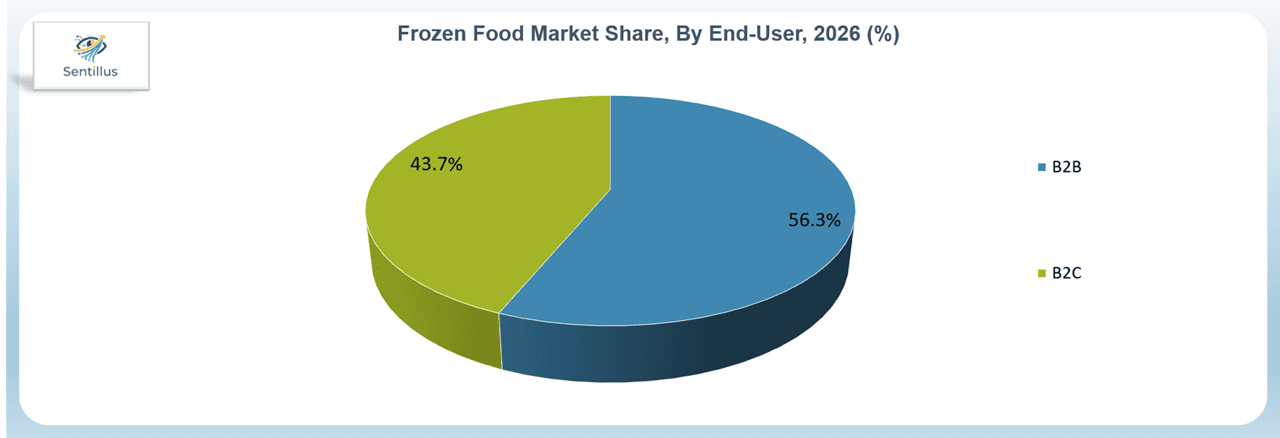
Distribution channel dynamics further demonstrate the commercial importance of modern retail infrastructure. B2B procurement was the largest segment in the consumption of the market during the forecast period due to continuous purchase by restaurants, hotels, institutions that cater and quick service restaurant chains that use frozen foods. B2C sales, on the other hand, will grow through the supermarkets, hypermarkets and even the rapidly growing online shopping platforms, where temperature controlled logistics make it possible for the direct distribution of frozen foods without loss of quality. The continuous developments in the organization of retail will hence drive both institutional procurement and household purchases and generate sustained demand in various segments while motivating innovations from the manufacturers.
Market Opportunity
Localization of Frozen Food Manufacturing Creates Long-Term Import Substitution Opportunities Across Emerging Economies
Increased manufacture of domestically produced frozen foods represents an attractive business opportunity for nations that wish to reduce reliance on imported processed foods, while building local food processing industry. Some developing nations have shown a higher rate of increase in consumption of frozen food as compared to its production, creating an excellent opportunity for investments in manufacturing plants, cooling plants and logistics chain setup. Manufacturing of frozen foods locally helps to reduce the cost of transport, keeps products fresher at the point of distribution and creates the ability for manufacturers to tailor their products according to the taste preferences in different parts of the region.
Government investments in local food processing industries together with increased private investments in food processing have contributed to the rapid expansion of the manufacturing in some developing nations. Recent investments of millions dollars announced by Godrej Tyson Foods, McCain Foods, etc. in Indian market show the economic potential of setting up food manufacturing plants in growing markets. Food manufacturers can achieve cost saving by purchasing agricultural raw material in local market. In addition, manufacturing of frozen food locally helps to reduce the cost associated with international shipping.
Localization also creates export opportunities for countries possessing competitive agricultural production and improving food processing capabilities. Investment in internationally recognized food safety management systems and compliance with export regulations enables manufacturers to supply neighboring regional markets while participating in global frozen food trade. Expansion of manufacturing capacity therefore supports multiple commercial objectives simultaneously, including import substitution, export diversification, employment generation, agricultural value addition and supply chain optimization. Companies establishing manufacturing operations in emerging economies during the current investment cycle are likely to benefit from expanding domestic consumption while positioning themselves to participate in future regional export growth as cold-chain infrastructure continues to mature.
Segment Analysis
By Product: Frozen Bakery Products & Snacks Account for the Largest Product Category Through Extensive Consumer Applications and Product Diversity
Frozen bakery products and snacks represented the largest product segment in 2026, accounting for USD 113.95 billion and are projected to reach USD 198.63 billion by 2035, expanding at a CAGR of 6.1%. Commercial leadership of this segment originates from its broad product portfolio, frequent consumption occasions and extensive penetration across both retail and foodservice channels. Product availability ranges from frozen breads, croissants and pastries to pizzas, finger foods, appetizers and bakery-based snack products, enabling manufacturers to address household consumption as well as institutional demand from hotels, cafés, restaurants and quick service restaurant chains. Diversity of product also enables manufacturers to offer a range of premium value added and regional-specific products without changing the existing facilities for freezing and distribution of the products.
The mass manufacture of frozen baked food and snack foods is well facilitated by the standardization of the manufacturing process, automation and use of freezing technology, which sustains the quality of the texture and moisture retention of the products during the distribution process. IQF, blast and spiral freezing are popular techniques used for this purpose. Long shelf life compared with fresh bakery products also minimizes retail waste, enabling supermarkets and convenience stores to maintain broader product assortments with improved inventory control and reduced replenishment frequency.
Retail distribution continues to represent the primary sales channel for frozen bakery products and snacks because supermarkets and hypermarkets allocate significant freezer space to high-turnover convenience products. Foodservice operators make up another key customer segment since frozen bakery items ensure uniform quality, preparation time and minimal manpower effort. Companies such as Nestlé, Conagra Brands, Nomad Foods, McCain Foods, Kellanova, General Mills and ITC keep introducing new items within frozen snacks and bakery ranges to cater to the evolving tastes of consumers and growing need for premium convenience food products. New product development is moving towards premium formulations, controlled portion sizes and flavors that are specific to certain regions.
By Distribution Channel: B2B Distribution Maintains Market Leadership Through Institutional Procurement and Foodservice Consumption
The B2B distribution has recorded the largest market share in terms of value amounting to USD 262.78 billion in 2026 and further expected to grow up to USD 439.17 billion by 2035, recording a CAGR of 5.9%. Large scale purchase of frozen foods by hotels, restaurants, institutional catering firms, hospitals, schools and quick service restaurants has been responsible for this growth. Institutional buyers seek standardization of product specifications, year-round availability and effective inventory management, making frozen food an essential element of institutional food preparation and large volume catering.
Efficiency is a crucial factor considered by institutional buyers when purchasing foodservice items. Frozen food reduces the preparation time and wastage of raw materials and ensures that portions remain consistent while reducing dependency on seasonal agricultural produce. Centralized procurement systems of restaurant chains and institutional buyers tend to favor the long-term procurement agreement with manufacturers who can provide products of consistent quality through integrated production and cold chain logistics processes. Food safety and supply chain security are important considerations in the procurement process and thus manufacturers have been forced to create internationally recognized quality management systems and automated manufacturing plants.
The business-to-consumer (B2C) sales continue to grow much faster compared to the institutional market on account of rising consumer inclination towards convenient meal solutions and availability of frozen food products through retail outlets. The online grocery is the fastest growing retail format in the B2C category since developments in last-mile delivery with temperature control have made the frozen food available outside the confines of the supermarkets. The supermarkets and hypermarkets continue to be the dominant retail distribution channel owing to high capacity freezers and product range. Continuous expansion of organized retail infrastructure is expected to strengthen both institutional procurement and household consumption while encouraging manufacturers to diversify product portfolios across multiple consumer price points and retail formats.
Geographical Analysis
Europe Maintains Market Leadership Through Mature Manufacturing Infrastructure and Integrated Intra-Regional Supply Chains
Europe had a high market share in global frozen food market worth USD 116.72 billion in 2026, forecasted to reach USD 183.32 billion in 2035 at a CAGR of 5.1%. Europe’s dominance is facilitated by an advanced food processing industry, efficient cold chain logistics and high acceptance of frozen food among the region’s consumers. Germany, UK and France are some of the biggest consumption zones, while the establishment of manufacturing plants by firms such as Nomad Foods, McCain Foods, Bonduelle, Greenyard, Ardo, FRoSTA and Dr. Oetker boosts the region’s production capacity. Efficient transport network and harmonization of food regulations allow free trade between members of the EU, where manufacturers can produce their goods optimally while still ensuring availability across the member states. High sales of premium frozen ready meals, bakery products, seafood and frozen vegetables are recorded in the region due to high consumer preference for convenient but high-quality products.
Germany is the largest country-level market in Europe generated USD 24.55 billion in sales in 2026, owing to its robust growth potential in the coming years due to sophisticated food processing capabilities, high supermarket coverage and significant frozen food consumption. UK remains a stable market for frozen convenience foods via existing retail channels and delivery systems at homes. France maintains significant commercial importance through diversified frozen bakery, dessert and vegetable production supported by a mature food processing industry and extensive agricultural output.
Asia-Pacific Records the Fastest Regional Expansion Through Rising Household Consumption and Manufacturing Investment
The Asia–Pacific is expected to experience the fastest growth rate with a CAGR of 8.3% from USD 131.25 billion in 2026 to USD 274.88 billion in 2035. Growing disposable income, increasing organized retail, rising refrigerator penetration and consistent investments in cold chain logistics are fueling the consumption of frozen foods in the region. Producers are investing in increased production capacity to become less dependent on imports and increase the efficiency of distribution in dense urban populations. The growing domestic demand in India and Southeast Asia is attracting investments in the manufacture of frozen foods due to higher growth in demand compared to current production capacity. The frozen food markets in Japan and South Korea are highly developed and feature high standards of products and diversified product offerings.
North America Demonstrates Stable Demand Supported by Established Retail Networks and Foodservice Procurement
The frozen foods market in North America accounted for USD 175.10 billion in 2026 and will grow to account for USD 262.61 billion by 2035, growing at a CAGR of 4.6%. Market maturity, availability of freezers and consumer behavior are some of the factors that have led to consistent demand of frozen products such as frozen meals, frozen bakery products, frozen pizza, frozen yogurt, frozen meat, frozen seafood, frozen peas and frozen potatoes. The largest country is US with market value of USD 118.55 billion in 2026 and expected to grow to account for USD 182.68 billion by 2035, growing at a CAGR of 4.9%. Canada will continue to have consistent consumption owing to its high household penetration of frozen convenience food, while Mexico will continue to benefit from increased organized retail and refrigerated infrastructure.
Competitive Landscape
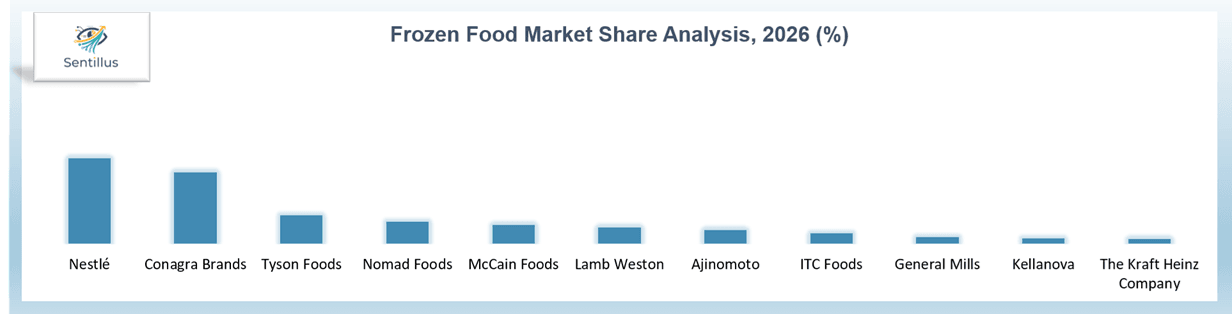
The competition within the global frozen food industry is moderately concentrated with multinational food companies competing against regional players and category specialists. The large companies have advantages due to their diverse range of products, production integration, distribution networks, and strong relations with organized retailers and institutions. Category specialization is still an important competitive feature as there are many companies leading in frozen potato products, frozen vegetables, frozen seafood, and frozen ready meals rather than in all categories of products.
Product differentiation is based on recipe innovation, product premiumization, packaging convenience, and regional taste adaptation rather than on price competition. The manufacturing investments are made in order to increase automation, efficiency, freezing technologies, and capacity in order to enhance operational performance and meet the increasing demand through retail and food service channels. The companies that have vertical integration of procurement and geographic diversification of manufacturing plants can better cope with raw materials availability and supply chain disruptions.
- Nestlé S.A.
- One of the biggest range of frozen food products for ready meals, frozen pizzas, and convenience foods under well-known consumer brands.
- Enhances its market position through consistent product innovation and international manufacturing and distribution abilities.
- McCain Foods Limited
- World’s largest producer of frozen potato products that cater to retail and food service clients across different regions.
- Increases its manufacturing ability along with investment in regenerative agriculture and sustainability.
- Nomad Foods Limited
- Runs some of the most successful frozen food brands in Europe with strong presence in frozen vegetables, seafood, and ready meals.
- Increases manufacturing capacity through manufacturing and portfolio innovations.
- Conagra Brands, Inc.
- Maintains diversified frozen meal and frozen snack portfolios targeting both mainstream and premium consumer segments.
- Focuses on brand expansion and value-added convenience food development.
- Tyson Foods, Inc.
- Strong commercial presence within frozen meat and prepared food categories supported by integrated protein production.
- Serves retail and institutional foodservice markets through diversified frozen protein offerings.
- General Mills, Inc.
- Participates through frozen meals, frozen breakfast products and convenience-oriented food brands.
- Leverages established retail relationships to strengthen category penetration.
- Kellanova
- Expands frozen breakfast and convenience food offerings through established consumer brands.
- Focuses on innovation within convenience-oriented product categories.
- Ajinomoto Co., Inc.
- Strong regional leadership across frozen ready meals and Asian convenience foods.
- Benefits from diversified manufacturing operations throughout Asia-Pacific and international markets.
- ITC Limited
- Expands frozen food portfolio within India through localized product development and integrated food processing capabilities.
- Benefits from strong domestic distribution and brand recognition.
- The Kraft Heinz Company
- Participates through selected frozen food categories supported by established consumer brands and international distribution.
- Focuses on value-added convenience products aligned with changing household consumption patterns.
Key Companies
BCG Matrix
| Quadrant | Companies | Strategic Position |
| Stars | Nestlé S.A., McCain Foods, Nomad Foods | Strong market position supported by diversified portfolios, manufacturing scale and continued investment. |
| Cash Cows | Conagra Brands, Tyson Foods, General Mills | Mature product portfolios with stable revenue generation across established frozen food categories. |
| Question Marks | ITC Limited, Ajinomoto Co., Ltd., Kellanova | Regional growth opportunities supported by portfolio expansion and increasing international presence. |
| Dogs | The Kraft Heinz Company | Selective participation in frozen food compared with broader packaged food operations. |
Regulatory Landscape
Regulations relating to food safety, product integrity and international trading are still the main regulatory drivers of the frozen food industry. International companies engaged in production need to observe various regulations related to food processing, labeling, hygiene, traceability, packaging, and importation prior to commercial distribution of their products. Regulatory compliance plays an important role in the manufacture, formula, exportation, and qualification of suppliers and therefore, it becomes a major factor of competitiveness.
The frozen food products are regulated under the FDA of US in accordance with Federal Food, Drug and Cosmetic Act (FFDCA) and 21 CFR Part 101. Both the regulatory measures have made some mandatory provisions for food labeling, ingredients list, nutrition facts, and food safety production methods. The commercialization of frozen food products in the US is regulated under the Food Safety Modernization Act (FSMA). Frozen food products distributed via public procurement channels should be in compliance with the relevant USDA inspection requirements.
The frozen food sector in Europe has a regulatory structure which is harmonized by the European Commission. Regulation (EC) No. 178/2002 (General Food Law) sets out the traceability, food safety and market surveillance for the member states, whereas Regulation (EU) No. 1169/2011 outlines the food information and labeling rules to be applied to the frozen food packed in packages. Official controls carried out in accordance with Regulation (EU) 2017/625 ensure food safety controls both for domestically produced and imported foods, which increase consumer trust and facilitate trade within Europe. The materials used in food packages should also comply with Regulation (EC) No. 1935/2004.
Global food safety standards such as Hazard Analysis and Critical Control Points (HACCP), ISO 22000, BRCGS Global Food Safety Standard and FSSC 22000 are also adopted in international trade. International retailers and institutional buyers often require these certifications before buying products because food safety management system provides an assurance of lower risks for business operation. Multinational food service providers also demand these standards from their suppliers as it ensures transparency of the supply chain process. Hence, manufacturers who wish to export their products keep on investing in these internationally recognized quality management systems.
Recent Developments
| Month | Company | Development | Commercial Impact |
| January 2026 | Nomad Foods | Invested £2.2 million on a new production line for potato waffles at the Lowestoft manufacturing plant in UK | Increased manufacturing capacity, increased efficiency of the manufacturing process and strengthened frozen food supply within the country. |
| June 2026 | Nomad Foods | Initiated the second Future Foods Lab innovation program in order to boost cooperation with food technology companies that develop future frozen meal solutions. | Increased innovation portfolio and product development capabilities. |
| July 2026 | Nomad Foods | Released its 2025 Sustainability Report detailing the company’s achievements in regenerative agriculture, responsible sourcing and manufacturing efficiency programs. | Strengthened sustainability and resilience of raw materials and manufacturing processes. |
| August 2025 | McCain Foods | Announced investment of approximately ₹3,800 crore for a new potato flakes and fries manufacturing facility in Madhya Pradesh, India. | Expanded production capacity in one of the fastest-growing frozen food markets while strengthening regional manufacturing localization. |
| February 2025 | McCain Foods | Expanded regenerative agriculture initiatives through development of an additional Farm of the Future demonstration project. | Improved long-term agricultural productivity and raw material security supporting frozen potato manufacturing. |
Future Outlook
In the coming years, growth within the industry will rely more on manufacturing efficiency, logistics efficiency, and diversification of production within the region than on mere product portfolio expansion. Businesses that have manufacturing operations spread out across various geographical locations, along with an efficient procurement system, are anticipated to gain better flexibility in operations as well as lower transportation costs. Expansion of capacity in Asia Pacific and South America is expected to enhance self-reliance in the region, thus decreasing reliance on imported frozen foods.
The consumer buying trend is likely to move towards premium convenience foods that need little or no preparation but retain their nutritional value and consistency. Thus, the food categories likely to receive more investment from product development are frozen ready-meals, premium bakery products, frozen snacks, and value-added seafood products. The companies able to bring about innovative premium products with economic production are bound to succeed competitively.
The development of cold-chain logistics continues to be one of the most significant structural determinants that will affect the performance of markets in the future. The development of refrigerated warehouses, temperature-controlled transport, and delivery capabilities will enhance the availability of frozen foods outside the major urban centers while helping online groceries gain more traction. Cold-chain logistics that include digital monitoring will help track temperatures and improve distribution efficiency.
International trade will continue facilitating product availability throughout the year despite growing localization of production. Export-oriented producers who work in compliance with international standards for food safety management are likely to gain from growing demand in developing countries where local production is unable to meet consumption needs. Thus, regulatory harmonization, ongoing investments in processing technology, and increased agricultural productivity are likely to ensure market stability and sustainable business growth in various frozen food products.
Frequently Asked Questions
Why Choose Sentillus?
Decision-Oriented Research
Sentillus delivers research designed for business decisions rather than information collection. Every study combines industry expertise, strategic analysis and practical market intelligence supporting investment, expansion and competitive planning.
Reliable Primary and Secondary Validation
Research integrates interviews with industry participants including manufacturers/service providers, dealers/distributors/agents/3rd-party suppliers and customers/consumers, public company disclosures, government publications, trade associations, consortiums, paid databases and verified industrial databases to improve analytical reliability.
Consultant-Level Industry Analysis
Every report explains why market changes occur, how competitive dynamics evolve and which developments create future business opportunities rather than simply presenting historical information.
Customized Business Intelligence
Clients receive research tailored to strategic priorities including market entry assessment, competitive benchmarking, supplier evaluation, investment opportunity analysis, pricing assessment and technology landscape studies.
Practical Competitive Insights
Competitive evaluation extends beyond company profiles by examining manufacturing capabilities, expansion strategies, product positioning, innovation priorities and strategic partnerships influencing industry leadership.
Comprehensive Regional Coverage
Country-level analysis evaluates industrial development, manufacturing capacity, production & yield, infrastructure investment, regulatory changes, trade activity and demand outlook across major global markets.
Continuous Research Support
Consultant assistance helps clients interpret findings, clarify market developments and understand industry trends after report delivery, ensuring greater value throughout the decision-making process.
High-Quality Research Standards
Every report follows a structured research methodology emphasizing data accuracy, logical analysis, clear business communication and actionable recommendations suitable for executives, investors and strategy planning teams.