

Overview
The US is the largest market for frozen foods globally due to the development of manufacturing capacity, agriculture production, cold-chain logistics and retail organization in the past few decades. Purchasing frozen food is no longer confined to convenience-oriented consumers. The restaurants, hospitals, education institutes, hotels, as well as contract caterers are playing a major role for commercial industry with regards to frozen foods for better inventory and better quality of their products throughout the year.
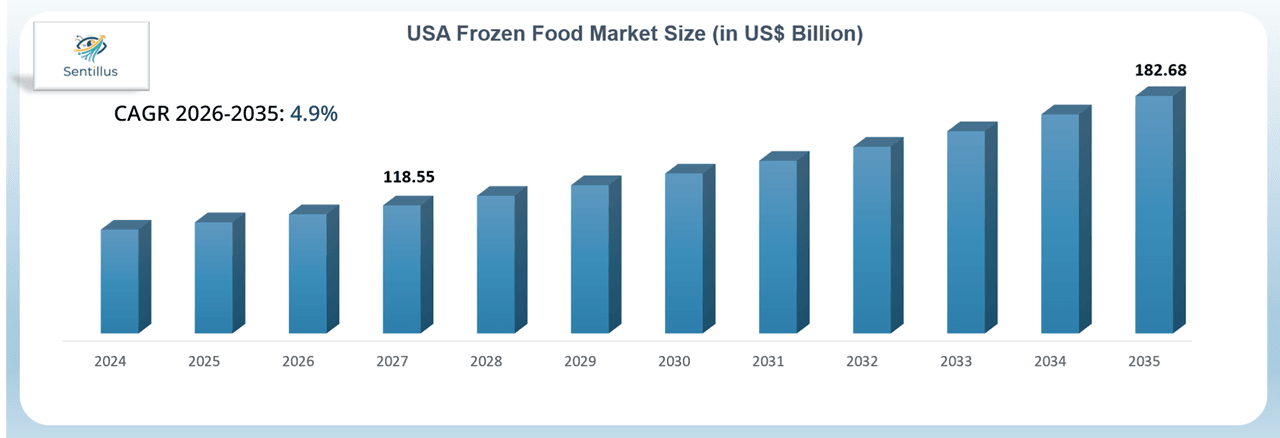
The US Frozen Food market reached USD 118.55 billion in 2026 and expected to rise to USD 182.68 billion in 2035 at a CAGR of 4.9%. Retail remains the main route, which is helped by supermarket chains present nationwide, warehouse clubs and grocery retailers. Frozen vegetables, ready meals, bakery items, meat, seafood and desserts continue to show consistent sales as frozen foods are increasingly marketed as premium convenience items rather than cheap food items by retailers. Innovation is becoming more important than consumer penetration in the frozen food industry. The food processing industry is still geographically dispersed in the country, where food processors can access agricultural raw materials efficiently while distributing their products to their national retail and foodservice clients through efficient cold chain logistics systems. It is thus less about production capacity and more about portfolio strength and relationships with retailers.
Market Driver
Institutional Food Procurement Provides Consistent Demand Across Multiple Industries
Institutional buyers still generating largest demand for frozen food products in United States. For quick service restaurants, hospitals, schools, airlines, and catering services, regular supply of food is important throughout the year with minimal processing and minimal waste. The advantage of long term supply contracts lies in the fact that they allow businesses to maintain a steady production and capacity utilization independent of the seasonality of fresh foods.
Market Opportunity
Premium Frozen Meals Continue Expanding Beyond Traditional Convenience Products
Consumers’ purchase patterns have increasingly gravitated towards high-end frozen meals with healthier ingredients, international cuisine, and more costly recipes. Freezers are constantly allocated with more shelf space for these types of solutions because premium products not only boost the margin within the category but also ensure better retention of customers. Companies that will be able to combine creativity in cooking with cold logistics will do very well.
Segment Analysis
By Product: Frozen Bakery Products and Snacks Maintain Category Leadership Through Frequent Consumer Purchases
Frozen bakery and snacks continue to be economically valuable products for the industry because consumers continue to buy such goods periodically. Products like breakfast goods, frozen pizza, and pastries are widely available for consumers and are also regularly accompanied by newly released flavors. A higher consumption level enables a faster turn-over of the inventory compared to some other categories of frozen proteins.
By Distribution Channel: Business-to-Business Distribution Continues Supporting Manufacturing Stability
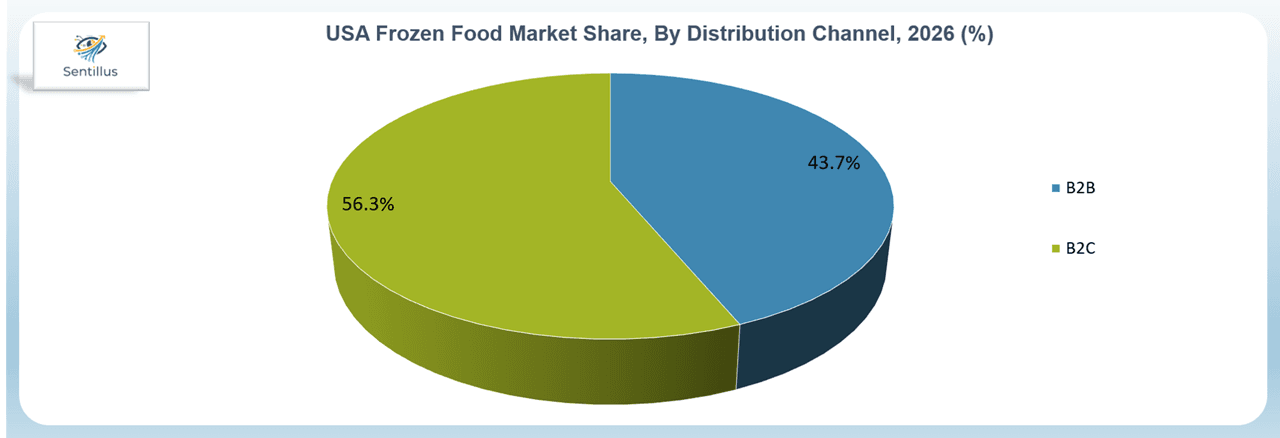
The business-to-business purchasing channel continues to be the biggest one due to the consistent purchase of huge volumes of product in supply contracts. Purchasers like foodservice distributors, chain restaurants, and healthcare institutions are more concerned about reliability of the product, food safety, and schedule of delivery rather than the prices.
Competitive Landscape
The competition is still dominated by multinational food companies operating in the market along with the category specialists and private label companies. Branding still plays a key role in consumer choice at the retail level, though the number of brands of frozen foods offered under the ownership of supermarkets has increased in the categories of ready meals, vegetables, desserts, and bakery.
These companies include Nestlé USA, Conagra Brands Inc., Tyson Foods Inc., General Mills, Inc., Kraft Foods Global Inc., McCain Foods Limited, and Ajinomoto Foods North America Corporation. Their diversified product lines and widespread manufacturing operations along with the refrigerated distribution network make them strong competitors.
Key Companies
BCG Matrix
| Quadrant | Companies | Commercial Position |
| Stars | Nestlé USA, McCain Foods | Strong product portfolios supported by nationwide retail and foodservice distribution. |
| Cash Cows | Conagra Brands, Tyson Foods, General Mills | Mature brands generating stable revenue across established frozen food categories. |
| Question Marks | Kraft Heinz, Ajinomoto Foods North America | Expanding premium convenience food portfolios with additional growth potential. |
| Niche Specialists | Regional frozen bakery and specialty food manufacturers | Category-focused businesses serving selected consumer segments. |
Regulatory Landscape
Frozen food manufacturing in the United States is regulated primarily under the Food Safety Modernization Act (FSMA) administered by the U.S. Food and Drug Administration (FDA). Preventive food safety controls, supplier verification and traceability remain central regulatory requirements for commercial manufacturers. Product labeling is governed under 21 CFR Part 101, while meat and poultry products fall under the inspection authority of the U.S. Department of Agriculture (USDA FSIS). Compliance with HACCP and internationally recognized food safety management systems remains essential for manufacturers supplying major retailers and institutional buyers.
Recent Developments
| Month | Company | Development | Commercial Impact |
| January 2025 | Nestlé USA | Expanded premium frozen meal portfolio. | Strengthened participation in higher-value convenience food categories. |
| March 2025 | Tyson Foods | Increased prepared food production capacity. | Improved supply capability for retail and foodservice customers. |
| July 2025 | Conagra Brands | Introduced new frozen snack products. | Expanded product portfolio across retail channels. |
| February 2026 | McCain Foods | Continued investment in frozen potato processing operations. | Improved production efficiency and long-term supply capability. |
Future Outlook
Future market expansion is expected to depend on product mix rather than rapid increases in consumption volume. The ready-meals which are healthy, premium and protein-based, along with those from restaurant kitchens, will most likely make up an increased proportion of future spending. The stable capacity utilization of manufacturing plants will be maintained by institutional buying, while automation, localized manufacturing, and improved logistics will increase efficiency. The businesses able to combine product innovation and nation-wide cold-chain distribution are going to enhance their competitiveness in the coming years.
Frequently Asked Questions
Why Choose Sentillus?
Decision-Oriented Research
Sentillus delivers research designed for business decisions rather than information collection. Every study combines industry expertise, strategic analysis and practical market intelligence supporting investment, expansion and competitive planning.
Reliable Primary and Secondary Validation
Research integrates interviews with industry participants including manufacturers/service providers, dealers/distributors/agents/3rd-party suppliers and customers/consumers, public company disclosures, government publications, trade associations, consortiums, paid databases and verified industrial databases to improve analytical reliability.
Consultant-Level Industry Analysis
Every report explains why market changes occur, how competitive dynamics evolve and which developments create future business opportunities rather than simply presenting historical information.
Customized Business Intelligence
Clients receive research tailored to strategic priorities including market entry assessment, competitive benchmarking, supplier evaluation, investment opportunity analysis, pricing assessment and technology landscape studies.
Practical Competitive Insights
Competitive evaluation extends beyond company profiles by examining manufacturing capabilities, expansion strategies, product positioning, innovation priorities and strategic partnerships influencing industry leadership.
Comprehensive Regional Coverage
Country-level analysis evaluates industrial development, manufacturing capacity, production & yield, infrastructure investment, regulatory changes, trade activity and demand outlook across major global markets.
Continuous Research Support
Consultant assistance helps clients interpret findings, clarify market developments and understand industry trends after report delivery, ensuring greater value throughout the decision-making process.
High-Quality Research Standards
Every report follows a structured research methodology emphasizing data accuracy, logical analysis, clear business communication and actionable recommendations suitable for executives, investors and strategy planning teams.