

 Overview
 Overview
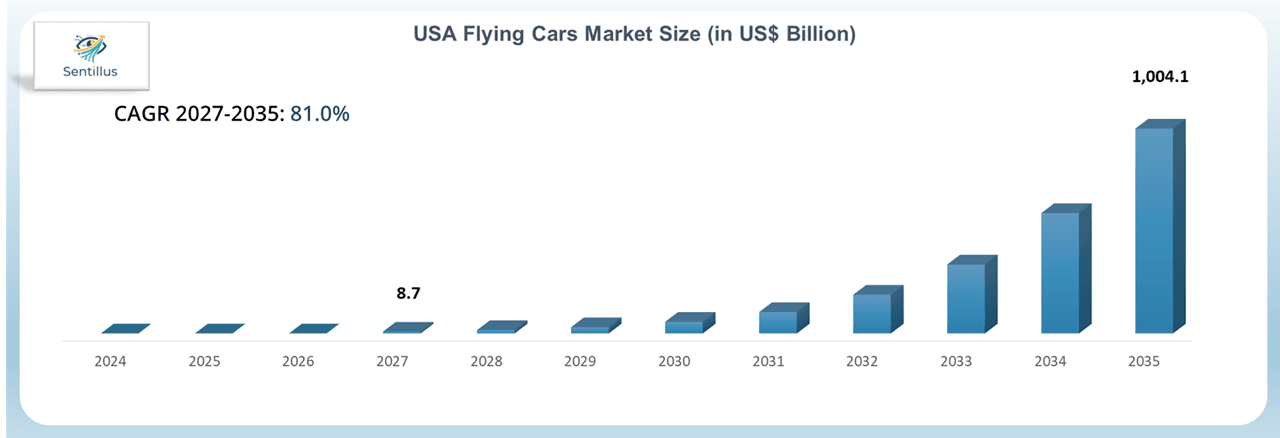
Flying cars are gradually moving beyond the experimental stage in the United States as regulatory progress, engineering innovation and private capital begin converging around a commercially viable Advanced Air Mobility ecosystem. Unlike previous aviation technologies that depended primarily on aircraft innovation, commercialization of flying cars requires simultaneous progress across certification, charging infrastructure, digital air traffic management, battery technology, software development and urban planning. Strong advancement across each of these areas is positioning the U.S. as one of the most influential markets shaping the next generation of personal and commercial aerial transportation. The USA Flying Cars Market is projected to grow from US$ 8.7 Billion in 2027 to approximately US$ 1 Trillion by 2035, registering a CAGR of 81.0% during the forecast period 2027-2035.
Commercial momentum is increasingly being driven by the country’s ability to transform aviation research into scalable businesses. American aerospace manufacturers benefit from an established supplier network, sophisticated engineering capabilities and access to deep pools of institutional and venture capital. Companies developing flying cars are no longer operating independently. Battery and semiconductor manufacturers, developers of AI software, cloud computing, telecommunication and airports are key players in the value chain. Joint effort across several industries is cutting down development times and fast-tracking commercial availability.
In place of fitting traditional rules for airplanes, aviation bodies are establishing their own regulatory frameworks that are tailored to powered-lift aircraft. Common rules on airworthiness, pilot qualifications, maintenance, and operation give manufacturers more assurance as to when their products will be ready for commercial use. Regulatory processes give investors a better feeling about potential investments, as regulatory benchmarks can be established in terms of technical parameters.
Private investments keep growing not only in the manufacture of aircraft but also in associated technologies. Artificial intelligence is now a crucial element in the development of next-generation aircraft with autonomous navigation, predictive maintenance, digital fleet management, and flight optimization. The software that can handle up to thousands of flights at once is gaining importance as a valuable business asset since the future of aerial mobility depends on traffic coordination as much as on aircraft themselves.
Key Technology
Electric propulsion systems remain a technological base for the industry. Advances in battery chemistry, thermal management, lightweight composites, and distributed electric propulsion allow for increased capacity and decreased maintenance needs. Modular aircraft design is being increasingly adopted by manufacturers, allowing the improvement of particular parts of the aircraft through its life cycle without redesigning the whole airplane. It allows not only better economics but also quick adaptation to advances in technology.
Consumer Perception
Public acceptance is slowly improving due to successful test flights, pilot projects, and certification milestones. People have already stopped considering flying cars as futuristic fantasies and started seeing them as means of transportation for some travel needs. Commercial operators are expected to reinforce public confidence through highly controlled early operations emphasizing safety, reliability and operational consistency before expanding toward larger customer segments.
Supply-Chain Analysis
Supply chain localization has emerged as another competitive advantage for the United States. Local manufacturing of batteries, semiconductors, avionics, electric motors and composite materials reduced dependency on imports and makes production more resilient. Government policies aimed at promoting advanced manufacturing and critical technologies will play a role in fostering localization within the flying cars industry.
Sales Economics
Economic value generated by the industry extends well beyond aircraft sales. Revenue opportunities are emerging across charging infrastructure, maintenance services, software licensing, digital fleet management, pilot training, insurance, battery lifecycle management, vertiport operations and mobility-as-a-service platforms. Recurring service revenues may ultimately exceed aircraft manufacturing revenue as commercial fleets expand across major metropolitan regions.
Commercial expansion is primarily supported by increasing aircraft certification, large-scale infrastructure investment, corporate fleet deployment, improving battery technology and gradual expansion of personal ownership. Combined progress across regulation, manufacturing, software and infrastructure positions the United States to become one of the world’s largest commercial markets for flying cars during the next decade.
Investment
Investment trends clearly demonstrate growing commercial confidence. Capital investments are now being made in facilities for manufacturing, software development, battery technology, autonomy, and other related areas, beyond mere validation of the concepts. Investments have shifted focus from mere demonstration of prototypes to manufacturing scalability, certification progress, and ecosystem development.
Market Dynamics
Driver: Mature Aerospace Innovation Ecosystem Accelerates Commercial Readiness
The U.S. aerospace innovation ecosystem is amongst the most established ecosystems for the development of flying cars commercially. Years of investments in commercial air transport, military applications, and advanced manufacturing have built an industrial infrastructure that can support large-scale commercialization efforts. The aircraft manufacturers are able to use the existing engineering workforce, certified parts suppliers, advanced test equipment, and manufacturing capabilities without having to create new industrial infrastructure. Strong industrial maturity reduces product development risk and shortens the timeline between prototype validation and commercial production.
Investment is continuously supporting the competitiveness of the industry. The number of venture capital companies, institutional investors, corporate venture capital organizations, and aerospace strategic investors that are starting to see the development of flying cars as a whole as part of the Advanced Air Mobility ecosystem rather than just another aircraft market segment is growing rapidly. The investment is becoming more focused on the companies that have made some progress on the issue of certification, scalability, and sustainable business model implementation.
Opportunity: Corporate Mobility Platforms Create High-Value Revenue Streams
Corporate transportation is expected to become one of the most commercially attractive opportunities in the United States because organizations increasingly prioritize employee productivity over conventional travel costs. Large enterprises operate across multiple locations including headquarters, manufacturing plants, research facilities, distribution centers and customer sites. Daily movement between those locations often requires several hours because highway congestion limits travel efficiency despite relatively short distances. Flying cars introduce a transportation model that converts travel time into productive business time while improving operational responsiveness.
Several industries are well positioned for early adoption. Tech companies require frequent interaction between innovation centers and customer facilities. Pharmaceutical organizations regularly transport executives, researchers and critical medical supplies between laboratories and production sites. Financial institutions depend on rapid executive mobility between regional offices and major business districts. Energy companies, engineering firms and infrastructure developers also maintain geographically distributed operations where travel efficiency directly influences project execution.
Fleet-based operating models strengthen the commercial value because organizations can access transportation capacity without purchasing aircraft. Subscription agreements, dedicated mobility contracts and enterprise transportation services reduce capital expenditure while providing predictable operating costs. Corporate customers also benefit from centralized maintenance, professional flight operations and digital scheduling platforms managed by specialist operators.
Digital integration further enhances customer value. Flight reservations, employee travel management, route optimization and expense reporting can be connected with existing enterprise software platforms. Artificial intelligence will continuously optimize fleet allocation based on travel demand, weather conditions and operational priorities. Such integration transforms flying cars from transportation assets into productivity platforms supporting broader business operations.
Commercial property developers are expected to become indirect beneficiaries. Business parks, innovation campuses and premium office developments equipped with vertiports may attract organizations seeking improved regional accessibility. Enhanced transportation connectivity could influence corporate real estate decisions while increasing the attractiveness of suburban commercial developments previously constrained by road congestion.
Segment Analysis
By Type: Roadable Aircraft Flying Cars Record the Fastest Expansion as Multi-Modal Transportation Gains Commercial Interest
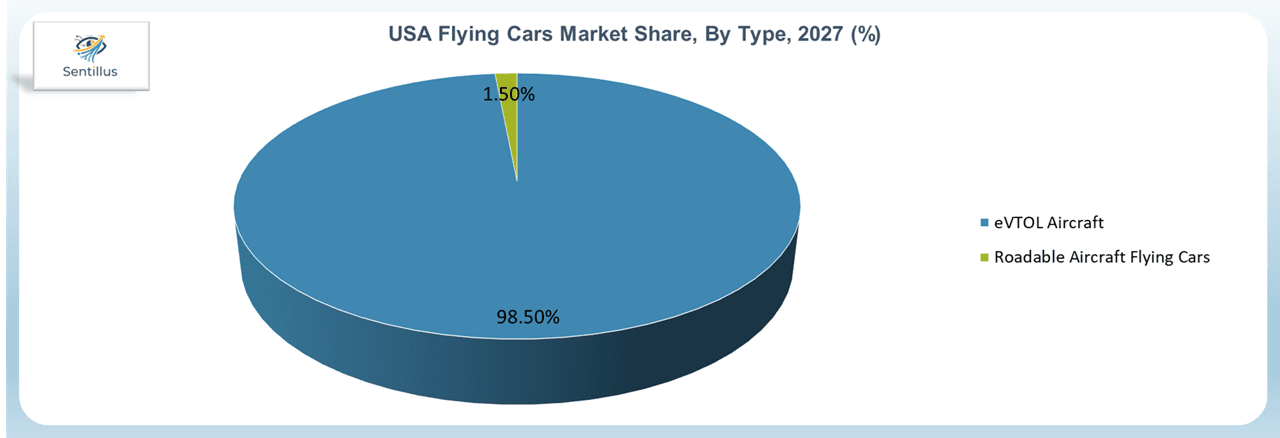
Roadable aircraft represent the most dynamic technology segment within the US because product development increasingly targets consumers seeking seamless movement between roads and controlled airspace. Growing interest reflects changing mobility preferences rather than simple aircraft innovation. Consumers and businesses increasingly value transportation flexibility capable of eliminating transfers between automobiles and aircraft while improving regional accessibility.
Engineering progress has significantly improved commercial feasibility. Compact propulsion systems, foldable wing structures, lightweight composite materials and integrated drive systems allow manufacturers to design vehicles capable of meeting both road and aviation performance requirements. Modularity is becoming an increasing aspect of product architecture, which allows future technology updates to be made without having to redesign entire vehicle platforms.
The certification process is also much more challenging in case of traditional eVTOLs because companies need to comply not only with automotive but also aviation certification processes. Regulatory complexity temporarily limits commercialization although successful certification will significantly expand future addressable markets by creating transportation products capable of serving multiple travel scenarios.
By Operation Mode: Autonomous Technologies Reshape Long-Term Commercial Economics While Piloted Aircraft Maintain Operational Leadership
Piloted aircraft will dominate commercial deployment because regulatory authorities continue emphasizing human oversight during early market expansion. Professional pilots provide operational assurance while manufacturers accumulate flight data supporting future certification of increasingly automated systems. Commercial operators also prefer experienced crews because passenger confidence remains closely linked with visible human supervision during initial service introduction.
Fleet efficiency is achieved by scheduling, energy and predictive maintenance of autonomous vehicles. The software constantly monitors the aircraft performance, batteries, and demand levels to ensure maximum efficiency and minimum downtimes in maintenance. The piloted aircraft have created the biggest market in the initial commercialization stage. However, autonomous systems are projected to show the most rapid growth over time due to rising regulatory acceptance and development of digital air transport. Advancements in artificial intelligence, computer power and communications give an autonomy a strong competitive edge in the next decade.
By Range: Medium-Range Aircraft Establish the Commercial Foundation While Long-Range Platforms Expand Future Mobility Networks
The medium-range flying car segment is expected to earn approximately US$ 3.6 billion during 2027 and is expected to grow further to US$ 483.8 billion by 2035. High levels of commercial demand are associated with wide usage in the segments of passenger transportation, corporate and medical transportation, where efficiency is the key purchase criteria.
Medium-range flying cars that will be able to cover distances ranging from 50 to 150 kilometers will be the cornerstone of the commercial market in the USA due to their ability to perform tasks corresponding to daily transportation needs of the largest urban areas. Most trips performed by corporations, airport transportation, medical transportation and regional businesses do not exceed this range, thus ensuring optimal utilization of aircraft and proper charging time of its batteries.
The long-range aircraft that will be able to operate on distances exceeding 150 kilometers will demonstrate the highest growth rate in the forecasted period. The development in terms of battery technology, weight-saving materials, software energy management systems and hybrid engines will ensure extended flight range without sacrificing the cargo capacity.
By Charging Type: Battery Electric Charging Maintains Leadership Through Infrastructure Compatibility and Lower Operating Costs
The battery-powered charging system is the best energy solution for flying cars since the infrastructure keeps on growing throughout the United States. The increase in the number of electric vehicles in the country has led to an increase in the capability of the energy supply network, including the installation of fast charging facilities. The flying cars will be positively affected by the developments because it is easier for vertiports to integrate the already existing energy infrastructure.
Power cost stability also supports battery electric adoption. Electricity prices generally fluctuate less than aviation fuel markets, allowing operators to forecast operating expenses with greater confidence. Predictable energy costs strengthen financial planning while improving the attractiveness of long-term transportation contracts signed with corporate customers, healthcare providers and government organizations.
Renewable energy integration also represents another benefit from a commercial standpoint. Airports, commercial properties and industries now consider investing in solar energy, battery systems and microgrids to facilitate vertiport operations in the future. Clean energy integration helps improve sustainability targets while decreasing dependency on traditional power sources when operations are at their peak.
Another critical technology has been battery monitoring systems. Analysis of temperature, charging frequency, degradation rate and other factors helps predict potential problems with batteries. Battery life increases lead to cost savings and higher profits.
By Application: Air Taxi Services Anchor Early Commercial Deployment While Personal Mobility Creates the Next Growth Wave
The air taxi passenger transport has the highest revenue shares due to the ability of commercial companies to launch their fleets immediately following certification without requiring widespread ownership of the vehicles. The fleet will be highly utilized compared to the private one since the companies will arrange continuous passenger transport at all times during the day, enabling them to earn from their investments.
Connectivity of the airport is among the early commercial benefits of the air taxi transport service. Most business people require a mode of transport that helps to save time by reducing their road trip from the airport to the center of town. Premium passengers will derive benefit from reduced time of travel as the usual road congestion makes their travel times unpredictable.
- Air taxi passenger transportation will remain the dominant application throughout the forecast period, reflecting strong demand from commercial operators seeking scalable transportation services supported by centralized fleet management.
- Personal mobility is expected to expand more rapidly than any other application category. The consumer preference in the transport industry is changing towards more independent, flexible, and regionally-connected transport services. Wealthy business people, entrepreneurs, and experienced users of private air transportation form the first customer group due to the importance of efficiency over purchase price.
By End-User: Commercial Fleet Operators Drive Initial Revenue While Private Ownership Delivers the Fastest Expansion
Commercial operators will remain the dominant customer group during the industry’s formative years because professional fleet management offers the strongest commercial economics. Due to the optimization of scheduling, pilots, and constant use of aircraft, operators can recuperate their initial investments much better than private owners. Moreover, transportation businesses have more operational skills, thus allowing them to expand quickly after obtaining the necessary permissions from authorities.
The mobility service providers tend to use the platform model of operation that combines aircraft scheduling, booking, payment solutions, and preventive maintenance systems in one digital ecosystem. The efficiency is achieved by software, which constantly adjusts the aircraft allocation to fit the passenger needs and weather conditions. Greater automation also reduces administrative costs while improving customer experience.
Competitive Landscape
Competition in the U.S. flying cars market is transforming into the competition for an ecosystem creation instead of just developing aircraft. U.S. producers are still enjoying one of the most advanced aerospace ecosystems in the world. Well-established aviation companies have plenty of experience in certifying aircraft and building ecosystems.
Strategic alliances is an important part of competitive strategy. Aircraft manufacturers are partnering with airlines, airports, infrastructure developers, battery producers, semiconductors and cloud computing firms to develop integrated transportation networks instead of simply manufacturing aircraft products. Alliance strategies give the manufacturer the ability to leverage complementary skills without incurring the cost of infrastructure development and platform creation.
Certification progress continues influencing competitive positioning because commercial deployment cannot begin without regulatory approval. Companies which are showing steady improvement in areas such as testing, documentation and validation increase customer confidence as well as bringing in more investment. Firms who can coordinate their certification with the expansion of their production capacity will likely get their early commercial contracts and build themselves a good market position before other players start competing hard.
The customer engagement model is changing as well. Commercial firms now need complete mobility systems which include not only the aircraft but also pilot training, maintenance, operations management, charging systems and fleet management services. Firms offering full service packages can build strong customer relations and recurring revenues.
Competition is therefore shifting toward ecosystem leadership rather than product leadership. Companies capable of combining engineering excellence with digital innovation, manufacturing efficiency and long-term operational support are expected to define the next phase of commercial growth across the United States flying cars market.
BCG Matrix
| Company | Position | Business Assessment |
| Joby Aviation | Star | Strong certification progress, expanding manufacturing capacity, strategic airline partnerships and comprehensive commercialization strategy position the company among the industry’s leading growth businesses. |
| Archer Aviation | Star | Large production investments, commercial fleet partnerships and strong regulatory engagement support rapid market expansion and long-term revenue growth. |
| Boeing | Cash Cow | Extensive aerospace expertise, financial strength and engineering resources provide significant competitive advantages although flying cars currently represent a relatively small portion of overall business activities. |
| Beta Technologies | Question Mark | Strong technological capability and expanding infrastructure initiatives create attractive long-term potential although commercial deployment remains in the early growth stage. |
| Wisk Aero | Question Mark | Autonomous aviation expertise and backing from established aerospace organizations strengthen future opportunities despite longer commercialization timelines. |
| Electra | Question Mark | Hybrid-electric technology and regional mobility strategy create attractive niche opportunities while commercial scale remains under development. |
| Lilium (U.S. Operations) | Question Mark | Strong aircraft innovation and premium mobility positioning offer future growth opportunities subject to certification and manufacturing execution. |
| Airbus Urban Mobility Programs | Cash Cow | Global aerospace capability supports continued investment although commercial activity within the United States remains limited compared with domestic competitors. |
| Emerging Startups | Dog | Innovative technologies remain under development although limited financial resources and slower certification progress reduce short-term competitive strength. |
Adoption Analysis
The introduction of flying cars in the USA is anticipated to be phased rather than sudden mass adoption. Fleet providers will lead the commercial rollout phase due to more efficient economics and regulations and greater aircraft usage in a centralized environment. Transport firms have the capability and know-how for adopting new aviation technologies and ensuring consistent safety levels.
Business customers will drive adoption through transport contracts. Large firms now consider employee mobility as an investment rather than a cost of doing business. Productivity benefits from connections between regional office locations, factories, customer locations and airports makes business mobility one of the first commercially viable applications.
Digital platforms will shape adoption; mobile booking applications, integrated travel planning, predictive maintenance systems and connected aircraft management simplify customer experience while improving fleet efficiency. Technology adoption therefore extends beyond aircraft ownership into complete digital mobility ecosystems.
“Commercial adoption is expected to progress through four distinct stages: demonstration programs, fleet deployment, enterprise mobility and consumer ownership. Each stage strengthens market confidence while creating operational data supporting subsequent expansion”
Disruption Analysis
Surface transportation may experience the first measurable impact. High-value business travel, premium commuting and airport transfers are likely to shift toward aerial mobility as operators demonstrate reliable commercial performance. The need for time-sensitive transportation presents an ideal scenario where travel efficiency is more important than the cost of the traditional means of transportation.
Who Should Buy This Report in 2026?
The Sentillus Flying Cars Market Report (2026 Edition) is designed for organizations involved in the development, investment, regulation, manufacturing, deployment, or adoption of Advanced Air Mobility technologies.
Aircraft Manufacturers
Identify commercialization opportunities, benchmark competing aircraft platforms, evaluate certification progress, and understand emerging technology trends shaping the future flying cars industry.
Automotive OEMs and Mobility Companies
Assess opportunities for diversification into aerial mobility, identify strategic partnerships, evaluate manufacturing opportunities, and understand future mobility business models.
Battery, Electronics, and Component Suppliers
Analyze future demand for electric propulsion systems, batteries, semiconductors, sensors, avionics, lightweight materials, and advanced manufacturing technologies supporting flying car production.
Government Agencies and Aviation Regulators
Understand global commercialization trends, certification developments, infrastructure requirements, and policy initiatives supporting Advanced Air Mobility deployment.
Infrastructure Developers and Airport Operators
Evaluate opportunities related to vertiports, charging infrastructure, maintenance facilities, multimodal transportation integration, and airport connectivity.
Venture Capital and Private Equity Firms
Identify high-growth technology developers, evaluate investment opportunities, benchmark competitive positioning, and assess long-term commercialization potential across different market segments.
Airlines and Mobility Service Providers
Develop future fleet strategies, evaluate operational business models, understand passenger demand trends, and identify opportunities within urban air taxi and regional mobility services.
Defense and Public Safety Organizations
Assess applications related to emergency response, disaster management, surveillance, border security, medical evacuation, and government transportation.
Research Institutions and Universities
Support technology development, policy research, battery innovation, autonomous flight systems, urban planning, and next-generation aerospace engineering initiatives.
Strategy Consultants and Corporate Planning Teams
Leverage independent market intelligence for strategic planning, competitive benchmarking, investment evaluation, partnership identification, and long-term business expansion within the rapidly evolving flying cars ecosystem.
Frequently Asked Questions
Why Choose Sentillus?
Decision-Oriented Research
Sentillus delivers research designed for business decisions rather than information collection. Every study combines industry expertise, strategic analysis and practical market intelligence supporting investment, expansion and competitive planning.
Reliable Primary and Secondary Validation
Research integrates interviews with industry participants including manufacturers/service providers, dealers/distributors/agents/3rd-party suppliers and customers/consumers, public company disclosures, government publications, trade associations, consortiums, paid databases and verified industrial databases to improve analytical reliability.
Consultant-Level Industry Analysis
Every report explains why market changes occur, how competitive dynamics evolve and which developments create future business opportunities rather than simply presenting historical information.
Customized Business Intelligence
Clients receive research tailored to strategic priorities including market entry assessment, competitive benchmarking, supplier evaluation, investment opportunity analysis, pricing assessment and technology landscape studies.
Practical Competitive Insights
Competitive evaluation extends beyond company profiles by examining manufacturing capabilities, expansion strategies, product positioning, innovation priorities and strategic partnerships influencing industry leadership.
Comprehensive Regional Coverage
Country-level analysis evaluates industrial development, manufacturing capacity, production & yield, infrastructure investment, regulatory changes, trade activity and demand outlook across major global markets.
Continuous Research Support
Consultant assistance helps clients interpret findings, clarify market developments and understand industry trends after report delivery, ensuring greater value throughout the decision-making process.
High-Quality Research Standards
Every report follows a structured research methodology emphasizing data accuracy, logical analysis, clear business communication and actionable recommendations suitable for executives, investors and strategy planning teams.