The Certified Reference Materials market is positioned for sustained expansion as analytical laboratories place greater emphasis on measurement traceability, reproducibility, regulatory defensibility and method-specific quality assurance. Certified Reference Materials serve as characterized materials with documented property values, measurement uncertainty and metrological traceability. Laboratories rely on them for quality control, analytical method validation, regulatory compliance testing, research and analytical development and calibration of sophisticated analytical instrumentation. Increasing regulatory scrutiny across pharmaceuticals, environmental monitoring, food safety, biotechnology, chemicals and industrial manufacturing continues to broaden their role within routine laboratory workflows.
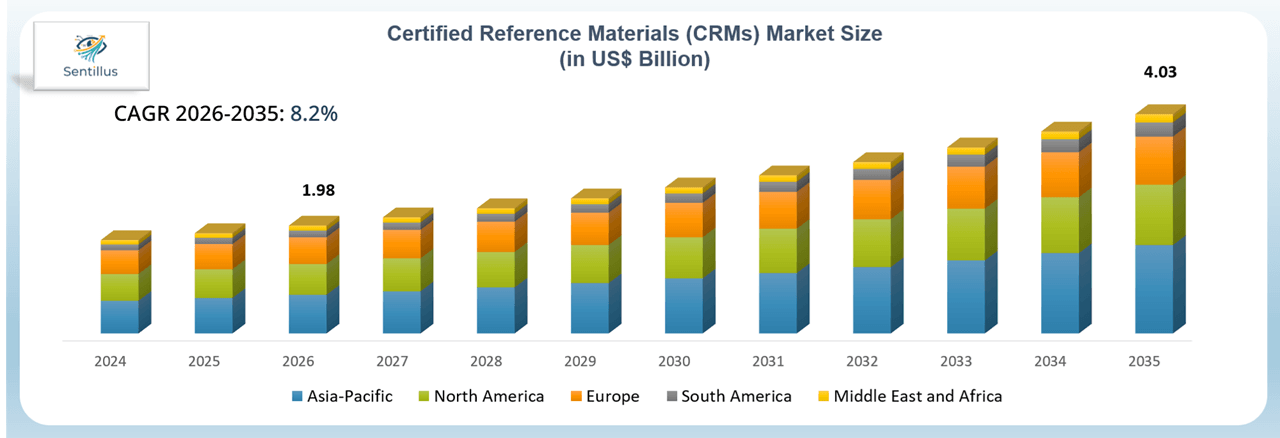
The global CRM market is valued at USD 1,982.90 million in 2026 and is projected to reach USD 4,030.80 million by 2035, expanding at a CAGR of 8.2% during 2026-2035. Growth increasingly reflects expansion of analytical testing volumes alongside a structural shift toward more sophisticated organic standards, matrix-matched materials, pharmaceutical reference substances, environmental contaminant standards and application-specific certified materials. Laboratories handling highly regulated or technically complex testing workflows increasingly require materials capable of supporting lower detection limits, multi-analyte methods and defensible measurement uncertainty.
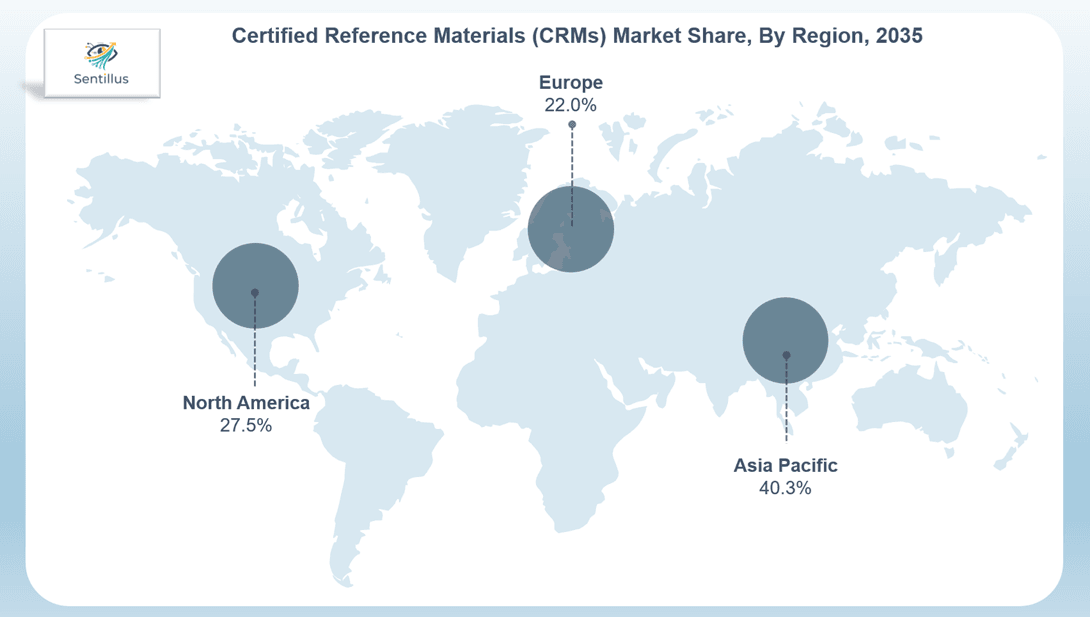
Regional demand demonstrates considerable differences in market maturity and underlying analytical requirements. Asia-Pacific leads the global CRM market with USD 710.50 million in 2026 and is projected to reach USD 1,624.64 million by 2035 at a 9.5% CAGR, making the region both the largest and fastest-growing major geographic market. Pharmaceutical and biotechnology manufacturing expansion, environmental monitoring, food export testing, electronics production and growing laboratory accreditation support regional CRM consumption. North America accounts for USD 565.12 million in 2026 and is projected to reach USD 1,108.58 million by 2035 at a 7.8% CAGR, supported by sophisticated laboratory infrastructure and stringent analytical requirements across environmental, pharmaceutical, clinical and food applications.
Europe represents USD 492.30 million in 2026 and is forecast to reach USD 885.12 million by 2035 at a 6.7% CAGR, with regulatory harmonization and established metrology infrastructure supporting recurring demand. South America increases from USD 122.93 million to USD 260.40 million at an 8.7% CAGR, reflecting expanding food testing, agricultural export certification, mining analysis and environmental monitoring. Middle East and Africa advances from USD 92.05 million to USD 152.06 million at a 5.7% CAGR, supported principally by petroleum testing, mining laboratories, environmental monitoring and gradually strengthening quality infrastructure.
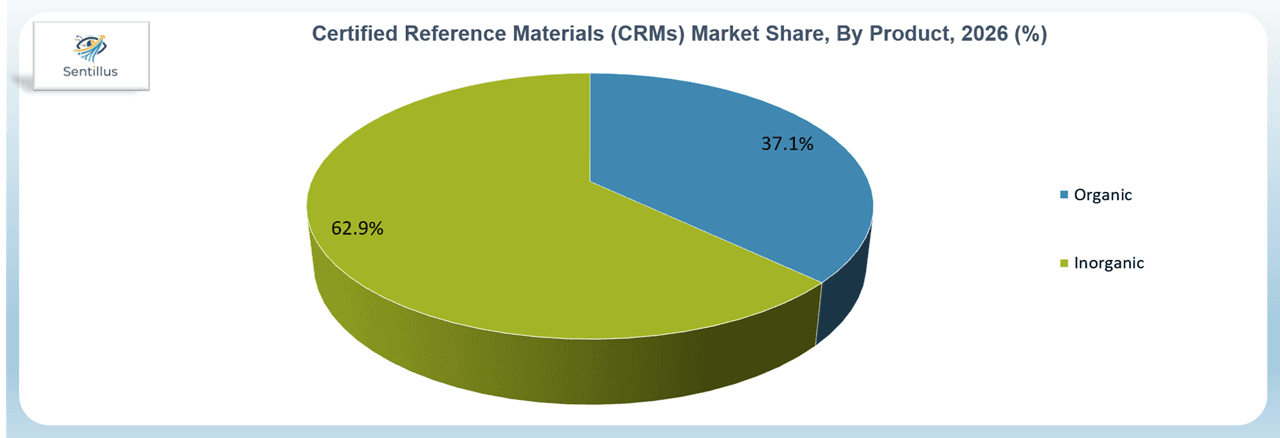
Demand composition is also changing as laboratories move beyond traditional inorganic calibration standards toward specialized organic compounds and increasingly complex analytical matrices. Inorganic CRMs remain the larger product category with USD 1,247.68 million in 2026, reflecting their extensive deployment across metals analysis, environmental testing, mining, industrial chemicals and elemental characterization. Organic CRMs represent the faster-growing product category with a 9.9% CAGR through 2035, supported by pharmaceutical impurity analysis, pesticide residue testing, PFAS monitoring, toxicology, food contaminants and emerging organic pollutants.
Application dynamics demonstrate a comparable movement toward technically intensive laboratory activities. Quality Control & Assurance remains the largest application with USD 648.08 million in 2026, reflecting recurring CRM consumption across production laboratories and regulated quality systems. R&D & Analytical Development represents the fastest-growing application at a 10.4% CAGR, demonstrating increasing demand for certified materials during method creation, compound characterization and advanced analytical research.
Healthcare represents the strongest growth opportunity among major end-use industries with an 11.2% CAGR, driven particularly by biotechnology and clinical diagnostics. Environmental testing maintains a substantial demand base and expands at 8.9%, supported by increasingly sophisticated monitoring of water, air, soil, waste streams and emerging contaminants. Contract testing also demonstrates strong expansion at 9.9% as regulated industries increasingly outsource specialized analytical workloads to accredited commercial laboratories and CROs.
Competitive positioning consequently depends on more than maintaining an extensive product catalogue. Accreditation scope, material characterization capability, matrix expertise, certificate quality, custom formulation capacity, stability assurance, stock availability and international distribution increasingly influence supplier selection. CRM manufacturers capable of translating new regulatory methods and emerging analytical requirements into certified products can capture opportunities before applications develop into standardized high-volume categories.
Market Dynamics
Regulatory authorities are widening the range of substances requiring accurate measurement across pharmaceuticals, environmental monitoring, food safety, chemicals and consumer products. Laboratories consequently need Certified Reference Materials that provide documented metrological traceability and measurement uncertainty rather than relying solely on internally prepared calibration materials. Increasing analytical scrutiny becomes particularly important when laboratory results determine product release, environmental compliance, contamination limits or regulatory enforcement.
Environmental regulation provides one of the strongest examples of this structural demand. PFAS monitoring is expanding across drinking water, wastewater and other environmental matrices while analytical methods increasingly require compound-specific calibration standards and isotope-labelled materials. Comparable requirements exist across food testing where laboratories measure pesticides, mycotoxins, heavy metals and processing contaminants against prescribed limits. Pharmaceutical laboratories face similarly demanding requirements around impurities, degradation products, assay validation and stability analysis.
Laboratory accreditation further reinforces CRM consumption. ISO/IEC 17025 requires testing and calibration laboratories to establish appropriate metrological traceability while ISO 17034 establishes competence requirements for reference material producers. Laboratories operating within regulated quality systems therefore increasingly procure materials from qualified producers whose certificates provide suitable characterization, uncertainty and traceability information.
Growing regulatory complexity also increases CRM consumption per analytical workflow. A laboratory implementing a new regulated method can require separate materials for calibration, method validation, recovery assessment, continuing quality control and instrument-performance verification. Regulatory expansion therefore creates recurring demand rather than a one-time requirement for analytical standards.
Market growth reflects this broader transition toward defensible measurement systems. Regulatory Compliance Testing is projected to expand at an 8.2% CAGR during 2026-2035 while Method Validation grows at 9.1%. Environmental Testing advances at 8.9% as laboratories respond to increasingly complex monitoring requirements. Suppliers capable of rapidly developing accredited materials around newly regulated analytes should consequently gain an advantage as environmental, pharmaceutical and food regulations continue increasing analytical requirements.
Healthcare represents an increasingly attractive growth frontier for Certified Reference Material manufacturers as biotechnology, pharmaceutical development and clinical diagnostics move toward more complex analytical workflows. Advanced therapies, biologics, precision diagnostics and increasingly sophisticated pharmaceutical products require laboratories to characterize materials with greater analytical sensitivity while demonstrating reproducibility across research, development and commercial quality-control environments.
The commercial opportunity extends considerably beyond conventional pharmaceutical assay standards. Biotechnology laboratories require characterized materials during analytical development, process characterization and quality assessment while pharmaceutical manufacturers need impurity standards, degradation products and reference substances throughout product development. Clinical laboratories create additional requirements for materials supporting assay verification and measurement comparability. Increasing analytical complexity raises the value of specialized CRMs because technically difficult materials require advanced characterization, stability assessment and controlled production.
Market segmentation demonstrates the scale of the opportunity. Healthcare represents the fastest-growing major end-use industry with an 11.2% CAGR during 2026-2035 while biotechnology records an even stronger 13.0% CAGR. Clinical diagnostics expands at 12.0% while pharmaceutical manufacturing advances at 10.4%. Growth rates materially exceed several established industrial CRM applications and indicate a gradual shift toward higher-value life-science reference materials.
Contract research also strengthens the opportunity because pharmaceutical and biotechnology companies increasingly rely on specialized external laboratories for analytical development and testing. CROs are projected to expand at a 10.9% CAGR within the CRM demand structure while broader Contract Testing grows at 9.9%. A reference material initially selected during outsourced analytical development can subsequently remain embedded within method validation and commercial quality-control procedures which creates recurring lifecycle demand.
CRM producers possessing pharmaceutical chemistry expertise, advanced characterization capabilities and ISO 17034-aligned production systems should therefore be particularly well positioned. Suppliers capable of developing difficult organic standards, custom reference materials and application-specific solutions can move beyond commoditized calibration products toward technically differentiated portfolios serving some of the fastest-growing analytical applications worldwide.
Segment Analysis
By Product: Inorganic Certified Reference Materials Maintain Market Leadership Across Established Analytical Workflows
The Certified Reference Materials market divides principally into organic and inorganic CRMs, with each category serving fundamentally different analytical requirements. Inorganic materials currently provide the larger revenue contribution because elemental analysis remains embedded across environmental monitoring, industrial quality control, metallurgy, mining, electronics, petroleum analysis and materials characterization. ICP-MS, ICP-OES, atomic absorption spectroscopy and X-ray fluorescence workflows depend extensively on certified elemental or matrix standards to establish calibration accuracy and verify measurement performance.
Inorganic CRMs retain considerable strategic relevance as advanced manufacturing increases requirements for accurate elemental characterization. Semiconductor fabrication requires exceptionally precise control of trace metallic contamination while battery materials demand reliable determination of lithium, nickel, cobalt, manganese and other constituents. Mining laboratories similarly depend on geological and ore-based reference materials for grade determination and process control. Circular material flows create another emerging requirement because recycled metals and battery black mass contain complex compositions requiring matrix-appropriate calibration.
Organic CRMs represent the more dynamic product category with a 9.9% CAGR during 2026-2035. Growth originates from the expanding number of structurally complex substances requiring quantitative analytical determination across pharmaceutical, environmental, food and toxicological laboratories. Pharmaceutical impurities, degradation products, pesticide residues, mycotoxins, PFAS compounds and organic contaminants create increasingly specialized demand that conventional inorganic reference materials cannot address.
Organic materials also present greater technical barriers concerning purity characterization, stability, storage and formulation. Suppliers possessing advanced chromatography, mass spectrometry, quantitative NMR and synthetic chemistry capabilities can consequently differentiate themselves within higher-value CRM niches. Continued expansion of LC-MS/MS and GC-MS analytical workflows should further strengthen commercial opportunities for multi-component organic mixtures and application-specific reference standards.
By Application: Quality Control and Assurance Remains the Primary Application for Certified Reference Materials
Certified Reference Materials support Quality Control & Assurance, Method Validation, Regulatory Compliance Testing, R&D & Analytical Development and Calibration & Instrument Validation. Application diversity provides the market with a recurring consumption base because CRMs participate throughout the analytical lifecycle rather than serving only initial instrument calibration.
Quality Control & Assurance represents the largest application with USD 648.08 million in 2026. Manufacturing laboratories, contract laboratories and accredited testing facilities routinely use certified materials to verify analytical performance and demonstrate continuing control over measurement processes. Recurring QC schedules create comparatively stable demand because materials must be replenished as inventories expire or testing volumes increase.
R&D & Analytical Development represents the fastest-growing application with a 10.4% CAGR through 2035. Pharmaceutical research, biotechnology development, environmental method development and advanced materials research increasingly require highly characterized substances during experimental method construction. Growing use of high-resolution mass spectrometry and other sensitive analytical platforms further increases demand for specialized reference substances capable of supporting quantitative method development.
Method validation represents another significant growth opportunity as laboratories must demonstrate analytical specificity, linearity, precision, accuracy and measurement reliability before deploying methods within regulated workflows. Regulatory compliance testing maintains recurring CRM consumption because analytical results supporting environmental, food, pharmaceutical and industrial compliance require defensible calibration and traceability. Instrument validation remains a comparatively mature application while continuing to provide stable baseline demand across spectroscopy, chromatography and elemental analysis.
Regional Analysis
Asia-Pacific Leads Global CRM Demand While Recording the Strongest Regional Expansion
Asia-Pacific represents the largest regional Certified Reference Materials market and also carries the strongest growth outlook among major regions. Pharmaceutical manufacturing, biotechnology, environmental monitoring, electronics production, mining and food-export testing collectively generate substantial analytical demand. China’s established industrial laboratory ecosystem provides considerable scale while expanding testing infrastructure across developing Asian markets creates additional opportunities. Increasing adoption of internationally aligned accreditation practices should progressively broaden demand for traceable certified materials.
North America Maintains a Mature Market Supported by Advanced Regulatory Testing Infrastructure
North America represents the second-largest regional market with a mature analytical infrastructure spanning environmental monitoring, pharmaceutical research, clinical diagnostics, food safety and industrial testing. United States laboratories represent the principal demand concentration while Canada provides a rapidly developing opportunity. Regulatory sophistication encourages use of specialized CRMs rather than reliance solely on conventional calibration standards which supports higher-value product categories.
Europe Combines Advanced Metrology Infrastructure With Extensive Regulatory Testing Requirements
Europe possesses one of the world’s most developed metrology and laboratory accreditation ecosystems. Regulatory harmonization across food safety, environmental monitoring, pharmaceuticals and chemicals creates substantial recurring demand while established national metrology institutions reinforce measurement traceability. Germany, the UK and France represent important commercial markets while European laboratories remain influential adopters of sophisticated matrix and application-specific reference materials.
South America Gains Momentum Through Food, Agriculture, Mining and Environmental Testing
South America represents a smaller but comparatively fast-growing market where environmental testing, mining, agricultural exports and food-safety requirements support expanding CRM consumption. Brazil provides the principal commercial opportunity within the region because its industrial scale and commodity-export structure create extensive analytical requirements. Increasing adoption of accredited testing methods can progressively raise CRM utilization across both government and private laboratories.
Middle East and Africa Develop Around Petroleum, Mining and Expanding Laboratory Quality Infrastructure
Middle East and Africa remain comparatively smaller markets although several specialized applications provide attractive opportunities. Petroleum and petrochemical testing represents an important demand source across Gulf countries while African mining laboratories create requirements for geological and metals CRMs. Food import testing and environmental monitoring provide additional growth avenues as laboratory quality infrastructure expands.
Regional Distribution and Inventory Capabilities Become Increasingly Important Competitive Factors
Geographical competition will increasingly depend on regional inventory availability alongside technical capability. Many certified materials possess storage limitations or specialized transport requirements which make local distribution commercially important. Suppliers capable of combining globally recognized accreditation with regional warehousing, technical support and reliable delivery can gain advantages in markets where laboratories currently depend heavily on imported materials.
Competitive Landscape
Global CRM Competition Remains Fragmented Across Diversified and Specialist Suppliers
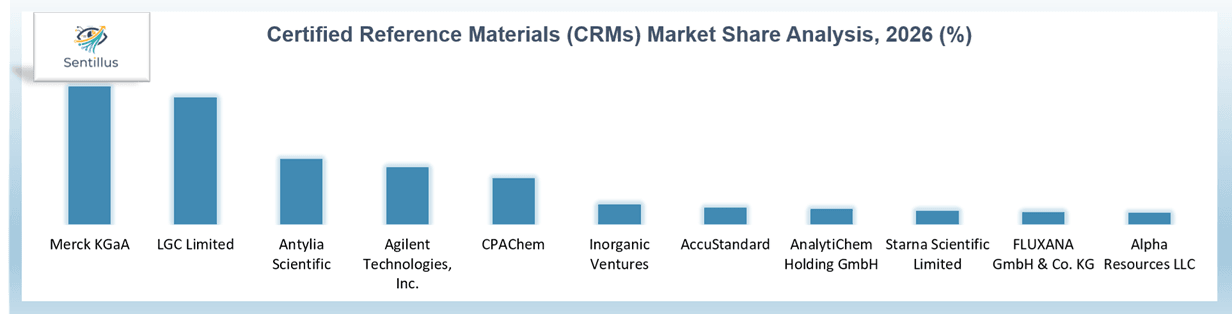
The global market remains fragmented across specialist reference-material producers, diversified life-science suppliers, national metrology institutions and application-specific CRM manufacturers. Companies including LGC Limited, AccuStandard, Antylia Scientific, Merck KGaA, Inorganic Ventures, CPAchem, AnalytChem, Starna Scientific and FLUXANA participate across different analytical niches.
Large diversified suppliers benefit from extensive distribution infrastructure and broad customer relationships while specialized manufacturers compete through technical expertise within specific chemistry or matrix categories. Inorganic specialists can differentiate through elemental formulation and trace-metal capabilities while spectroscopy-focused suppliers compete through instrument-validation expertise. Mining CRM manufacturers possess defensible positions where geological matrix preparation and homogeneity present substantial technical barriers.
Competitive strategy increasingly centers on portfolio responsiveness rather than catalogue breadth alone. Emerging contaminants can create demand for new standards rapidly after regulatory methods are introduced. Suppliers possessing strong analytical characterization and product-development capability can commercialize new CRM families faster which improves positioning within emerging applications.
Custom CRM capability represents another increasingly important differentiator. Laboratories developing proprietary methods or testing unusual matrices cannot always rely on catalogue materials. Bespoke formulations and matrix-specific materials therefore provide suppliers with opportunities to build deeper technical relationships and participate in higher-value analytical programs.
Regulatory and Accreditation Landscape
Regulation represents one of the strongest structural foundations supporting Certified Reference Materials demand because laboratories require traceable standards whenever analytical results determine regulatory compliance, product release, environmental enforcement or public-health decisions. Regulatory requirements increasingly extend beyond conventional elemental analysis toward emerging contaminants, complex food matrices, pharmaceutical impurities and multi-residue analytical methods. ISO-based laboratory accreditation strengthens the commercial relationship further because laboratories operating under formal quality systems require documented traceability and suitable reference materials for calibration, validation and continuing quality assurance.
CRM manufacturers consequently operate within two overlapping regulatory environments. Producer and laboratory accreditation frameworks determine how certified materials are produced and applied while sector-specific regulations determine which substances laboratories must quantify and at what analytical performance level. Environmental regulation has become particularly influential as PFAS and other emerging contaminants move into standardized monitoring programs. Food regulation generates another substantial demand pool through contaminant limits and pesticide residue controls while pharmaceutical frameworks sustain requirements for impurity profiling, stability testing and analytical method validation.
Requires chemical characterization and regulatory information across substances placed within the European market
Supports analytical standards for restricted substances, chemical impurities and environmental contaminants
Regulatory evolution also changes the composition of CRM demand rather than simply increasing overall testing volumes. PFAS provides a strong example because standardized mass-spectrometric methods require not only native analyte standards but also isotope-labelled analogues and carefully formulated multi-component solutions. Comparable effects occur when food authorities introduce lower contaminant limits or pharmaceutical guidelines expand impurity characterization requirements. Regulatory development consequently creates opportunities for CRM suppliers capable of translating analytical requirements rapidly into appropriately characterized commercial products.
ISO 17034 remains particularly important because accreditation provides a major indicator of producer competence within commercial procurement. ISO identifies ISO 17034:2016 as the currently published edition while revision work toward a second edition progressed into committee-draft development during July 2026. Future changes remain subject to the standards-development process although producers should monitor evolving requirements because eventual revisions could affect quality systems, characterization practices and accreditation procedures.
Key Developments
Competitive activity within the Certified Reference Materials market increasingly reflects portfolio specialization, acquisition-led consolidation, accreditation expansion and product development around emerging analytical requirements. Companies are extending beyond conventional elemental standards toward pharmaceutical reference substances, PFAS materials, spectroscopy standards, critical-mineral products and matrix-specific solutions.
Company
Activity
Date
Key Development
Strategic Relevance to CRM Market
LGC Limited
Acquisition
February 2026
Acquired the ChromaDex Reference Standards business to strengthen pharmaceutical and food-safety reference-standard capabilities
Expands LGC’s position within high-value organic standards and regulated pharmaceutical analytical workflows
LGC Limited
Acquisition
December 2024
Acquired DiaMex and expanded serology and molecular quality-control capabilities serving clinical laboratories
Broadens exposure to healthcare laboratory quality assurance and specialized diagnostic reference products
AccuStandard
Product Launch
February 2026
Released standards addressing cyclic volatile methyl siloxanes and pesticide-related analytical requirements
Strengthens responsiveness to evolving European environmental and food analytical requirements
Presented developments involving XRF calibration standards and automated sample-dosing workflows
Strengthens integration between reference materials and reproducible XRF sample preparation
FLUXANA GmbH
Methodology Development
2025
Developed specialized materials supporting XRF analysis of recycled battery black mass
Positions the company within emerging battery recycling and circular-material analytical workflows
Recent developments reveal four important strategic directions shaping competition. Acquisition activity is consolidating specialized reference-standard portfolios within larger laboratory-solution organizations while accreditation expansion is allowing producers to enter technically differentiated CRM categories. Product development increasingly follows regulation directly with PFAS providing a prominent example of standards being commercialized around specific analytical methods. Critical minerals and battery recycling are simultaneously creating an emerging CRM application where complex matrices require new calibration and quality-control materials.
Healthcare and pharmaceutical applications represent another major direction for portfolio investment. LGC’s expansion within reference standards and Antylia Scientific’s CRM portfolio coordination illustrate the commercial attractiveness of high-value analytical materials used within regulated life-science workflows. Organic standards can provide stronger differentiation because impurity substances and complex pharmaceutical materials require considerably greater characterization expertise than routine inorganic solutions.
Environmental product development is becoming increasingly method-specific. Laboratories implementing PFAS workflows require standards compatible with targeted compounds, analytical matrices and isotope-dilution methods rather than generic environmental calibration products. Producers capable of aligning product launches closely with EPA, European and other standardized methods can therefore establish early positions as laboratories implement new testing programs.
Critical-mineral and circular-economy applications represent a developing competitive frontier. AnalytChem’s critical-mineral CRM development and FLUXANA’s work around recycled battery black mass demonstrate how the market is extending into battery supply chains. Analytical requirements covering lithium, nickel, cobalt, manganese and contaminant elements create opportunities across mineral exploration, refining, battery manufacturing and recycling.
Future Outlook
The Certified Reference Materials market should progressively shift toward more specialized, application-driven and digitally integrated products through 2035. Conventional inorganic standards will remain essential to routine laboratory operations while incremental value creation increasingly originates from complex organic substances, emerging contaminants, pharmaceutical impurities and matrix-specific materials.
Healthcare should become an increasingly influential source of industry growth as biotechnology and clinical diagnostics expand analytical complexity. Biological products and advanced therapies require sophisticated characterization while pharmaceutical development continues increasing the number of specialized analytical standards required across research, validation and commercial quality control. CRM manufacturers capable of developing technically difficult healthcare materials should consequently gain access to relatively high-value applications.
Environmental laboratories should provide another major source of product innovation. PFAS demonstrates how an emerging contaminant class can rapidly generate requirements across multiple individual compounds, mixtures, isotope-labelled standards and environmental matrices. Similar opportunities can develop around additional persistent chemicals and previously unmonitored substances as environmental science advances and regulatory frameworks respond.
R&D and analytical development will become increasingly important because modern laboratories are adopting more sensitive instrumentation and sophisticated analytical methodologies. High-resolution mass spectrometry, advanced chromatography and increasingly automated analytical platforms require well-characterized materials during method construction. Suppliers engaging laboratories during method-development stages can establish product relevance before workflows transition into routine compliance testing.
Critical minerals and circular-economy applications create another emerging opportunity. Battery manufacturing, mineral processing and recycling require reliable measurement of valuable elements alongside potentially harmful impurities. Certified materials representing battery powders, ores, refined intermediates and recycled black mass can become increasingly relevant as global battery supply chains mature.
Digital CRM documentation may eventually reshape how laboratories manage traceability. Machine-readable certificates and integrated laboratory information systems could reduce manual data entry while improving control over lot numbers, expiration dates, certified values and measurement uncertainty. Digital certification can also strengthen audit readiness by maintaining structured traceability information across laboratory workflows.
Regulatory alignment should continue strengthening the underlying requirement for competent CRM production. Development work surrounding the next edition of ISO 17034 signals continuing evolution of international expectations governing reference material producers. Producers investing in quality infrastructure and technical characterization capability should remain better positioned to address future accreditation requirements.
Long-term market competition will therefore increasingly reward suppliers capable of combining metrological competence, specialized chemistry expertise, regulatory responsiveness, custom manufacturing, regional availability and digital integration. Portfolio scale will remain valuable while technical credibility should become increasingly decisive as analytical applications grow more complex. The market’s expansion toward USD 4.03 billion by 2035 ultimately reflects a broader transformation within laboratory science where measurement accuracy and traceability are becoming integral requirements across an expanding range of commercial and regulatory decisions.
Expanding PFAS and Environmental Monitoring Requirements
Tightening Food and Environmental Testing Requirements Expand the Need for Matrix-Specific CRMs
Restraints
Impact Analysis - Drivers and Restraints
Opportunity
Biotechnology and Advanced Healthcare Testing Create a High-Growth Opportunity for Specialized CRMs
Digital CRMs Could Transform Reference Material Accessibility and Long-Term Analytical Traceability
Semiconductor and Advanced Materials Manufacturing Creates New High-Purity CRM Requirements
Trends
Challenges
Industry Analysis
Porter's Five Force Analysis
PESTEL Analysis
Geopolitical Analysis
Supply/Value Chain Analysis
Pricing Analysis
Regulatory Analysis
Innovation and R&D Trends
Sustainability and ESG Analysis
Risk Avoidance Model
Go-To-Market (GTM) Strategy
BCG Matrix
Tariff Analysis
Trade Policies Influencing The Market
Cost Impact Factors
Supply Chain Disruptions
Trade Analysis
Export
Import
Trade Gap
Trade Opportunities
Business Models Analysis
Demand-Supply Gap
Risk Mitigation Framework
Compliance Roadmap
Strategic Implications
Emerging Opportunities
Adoption Trends
Disruption Analysis
Analyst Opinion
By Product
Introduction
Market Size(USD Billion), Y-o-Y Growth (%), CAGR (%) and Analysis, By Product
Market Attractiveness Index, By Product
Organic
Inorganic
By Application
Introduction
Market Size(USD Billion), Y-o-Y Growth (%), CAGR (%) and Analysis, By Application
Market Attractiveness Index, By Application
Quality Control & Assurance
Method Validation
Regulatory Compliance Testing
R&D & Analytical Development
Calibration & Instrument Validation
By End-User
Introduction
Market Size(USD Billion), Y-o-Y Growth (%), CAGR (%) and Analysis, By End-User
Market Attractiveness Index, By End-User
Consumer Industry
Contract Testing
University / Non-Profit
Energy Industry
Environmental Testing
Healthcare
Industrial / Manufacturing
Materials / Mining
By Region
Introduction
Market Size (USD Billion), Y-o-Y Growth (%), CAGR (%) and Analysis, By Region
Market Attractiveness Index, By Region
North America
Introduction
Key Region-Specific Dynamics
Market Size (USD Billion), Y-o-Y Growth (%), CAGR (%) and Analysis, By Product
Market Size (USD Billion), Y-o-Y Growth (%), CAGR (%) and Analysis, By Application
Market Size (USD Billion), Y-o-Y Growth (%), CAGR (%) and Analysis, By End-User
Market Size (USD Billion), Y-o-Y Growth (%), CAGR (%) and Analysis, By Country
U.S.
Canada
Mexico
Asia-Pacific
Introduction
Key Region-Specific Dynamics
Market Size (USD Billion), Y-o-Y Growth (%), CAGR (%) and Analysis, By Product
Market Size (USD Billion), Y-o-Y Growth (%), CAGR (%) and Analysis, By Application
Market Size (USD Billion), Y-o-Y Growth (%), CAGR (%) and Analysis, By End-User
Market Size (USD Billion), Y-o-Y Growth (%), CAGR (%) and Analysis, By Country
China
India
Japan
Australia
South Korea
Indonesia
Malaysia
Philippines
Thailand
Vietnam
Rest of Asia-Pacific
Europe
Introduction
Key Region-Specific Dynamics
Market Size (USD Billion), Y-o-Y Growth (%), CAGR (%) and Analysis, By Product
Market Size (USD Billion), Y-o-Y Growth (%), CAGR (%) and Analysis, By Application
Market Size (USD Billion), Y-o-Y Growth (%), CAGR (%) and Analysis, By End-User
Market Size (USD Billion), Y-o-Y Growth (%), CAGR (%) and Analysis, By Country
Germany
UK
France
Italy
Spain
Netherlands
Rest of Europe
South America
Introduction
Key Region-Specific Dynamics
Market Size (USD Billion), Y-o-Y Growth (%), CAGR (%) and Analysis, By Product
Market Size (USD Billion), Y-o-Y Growth (%), CAGR (%) and Analysis, By Application
Market Size (USD Billion), Y-o-Y Growth (%), CAGR (%) and Analysis, By End-User
Market Size (USD Billion), Y-o-Y Growth (%), CAGR (%) and Analysis, By Country
Brazil
Argentina
Rest of South America
Middle East and Africa
Introduction
Key Region-Specific Dynamics
Market Size (USD Billion), Y-o-Y Growth (%), CAGR (%) and Analysis, By Product
Market Size (USD Billion), Y-o-Y Growth (%), CAGR (%) and Analysis, By Application
Market Size (USD Billion), Y-o-Y Growth (%), CAGR (%) and Analysis, By End-User
Market Size (USD Billion), Y-o-Y Growth (%), CAGR (%) and Analysis, By Country
UAE
Saudi Arabia
South Africa
Nigeria
Rest of Middle East and Africa
Competitive Landscape
Competitive Scenario
Market Share Analysis 2025 - Global
Mergers and Acquisitions Analysis
Partner Identification Analysis
Investment & Funding Landscape
Strategic Alliances & Innovation Pipeline
Company Profiles
Merck KGaA
Company Overview
Product Portfolio and Description
Revenue Analysis
Pricing Analysis
SWOT Analysis
Recent Developments
Major Deals
Expansion
Merger and Acquisition
Collaboration
Product Launches
Joint Ventures
Partnerships
Innovations
Recent News
Events
Conferences
Symposiums
Webinars
LGC Limited
Antylia Scientific
Agilent Technologies, Inc.
CPAChem
Inorganic Ventures
AccuStandard
AnalytiChem Holding GmbH
Starna Scientific Limited
FLUXANA GmbH & Co. KG
Alpha Resources LLC
Appendix
About Us and Services
Contact Us
Who Should Buy This Report in 2026?
The Sentillus Certified Reference Materials Market Report (2026 Edition) is designed for organizations involved in analytical testing, laboratory quality assurance, metrology, pharmaceuticals, chemicals, food testing, environmental monitoring, materials characterization, research and regulatory compliance across global markets.
Certified Reference Material Manufacturers
Evaluate demand across certified reference materials for chemical, biological, environmental, pharmaceutical, food, geological and materials testing applications. The report supports portfolio development, certification capabilities, production planning, geographic expansion and competitive benchmarking.
Analytical Testing Laboratories
Assess requirements for certified reference materials used in method validation, calibration, measurement verification, quality control and analytical accuracy. Analysis supports procurement planning, supplier evaluation and laboratory quality-management strategies.
Pharmaceutical and Biotechnology Companies
Understand demand for certified reference materials used in pharmaceutical analysis, assay testing, impurity characterization, drug development, quality control and regulatory submissions. The research supports analytical standard selection, laboratory planning and quality-assurance activities.
Chemical and Petrochemical Companies
Evaluate certified reference material requirements for chemical composition analysis, calibration, process quality control, raw-material testing and product characterization. The report helps organizations assess laboratory requirements and supplier opportunities.
Food and Beverage Testing Companies
Analyze demand for certified reference materials used in nutritional analysis, contaminant testing, food authenticity assessment, residue analysis and quality control. Analysis supports laboratory procurement, analytical method validation and regulatory compliance.
Environmental Testing Laboratories
Assess opportunities associated with certified reference materials for water, soil, air, waste and contaminant analysis. The report supports laboratory quality assurance, analytical validation and monitoring requirements across environmental testing applications.
Government Laboratories and Regulatory Agencies
Understand demand for certified reference materials supporting regulatory testing, measurement traceability, public-sector laboratories, environmental monitoring, food safety and industrial compliance. The research supports laboratory planning, standards development and regulatory testing programs.
Research Institutions and Universities
Evaluate applications for certified reference materials across analytical chemistry, materials science, environmental research, life sciences and experimental validation. The report supports laboratory procurement, research planning and development of reliable measurement methodologies.
Metrology Institutes and Standards Organizations
Assess market opportunities associated with measurement traceability, reference standards, calibration systems and laboratory accreditation. Analysis supports standards development, certification infrastructure and international measurement harmonization.
Materials and Industrial Testing Companies
Analyze demand for certified reference materials used in metals, minerals, polymers, ceramics, advanced materials and other industrial testing applications. The research supports analytical accuracy, quality control, material characterization and laboratory standardization.
Laboratory Instrument and Analytical Technology Companies
Understand how certified reference material adoption supports analytical instruments, calibration workflows, validation procedures and laboratory quality systems. The report helps instrument manufacturers identify complementary product opportunities, partnerships and customer requirements.
Investors, Private Equity and Corporate Strategy Teams
Identify market-entry opportunities, benchmark major certified reference material providers, assess laboratory testing trends, evaluate geographic expansion opportunities and analyze long-term prospects across the global reference materials ecosystem.
Methodology
How Sentillus develops the Certified Reference Materials (CRM) Market research report
Sentillus develops the Certified Reference Materials (CRM) Market research report through a documented methodology combining primary research, secondary research, market sizing, competitive landscape analysis, forecasting, and multi-stage data validation.
Market-specific research focus
For the Certified Reference Materials (CRM) Market, research places additional emphasis on technology adoption, product capabilities, software/platform development, deployment models, customer adoption, vendor positioning, innovation activity, and digital transformation trends.
01
Industry intelligence
Primary Research
Primary research sources include:
Manufacturers
Raw material suppliers
Distributors
Technology providers
Industry consultants
Regulatory experts
Business executives
Procurement professionals
Channel partners
Other industry stakeholders
Technology buyers and enterprise users
System integrators and implementation partners
Information collected through primary research includes:
Market dynamics
Demand patterns
Supply conditions
Pricing trends
Customer adoption
Technology developments
Competitive positioning
Future business outlook
Primary research is used as a validation layer and is not treated as the sole source of market conclusions.
02
Evidence base
Secondary Research
Secondary research sources include:
Government publications
Regulatory authorities
Customs and trade databases
Company annual reports
Investor presentations
SEC and exchange filings
Industry associations
Technical publications
White papers
Patent databases
Corporate press releases
Academic publications
International organizations
Technology product documentation
Technology adoption studies
Information gathered through secondary research includes:
Industry structure
Company activities
Production trends
Trade flows
Regulatory developments
Technology evolution
Investment activity
Market segmentation
Multiple independent sources are compared to improve consistency and reduce dependence on any single source.
03
Quality control
Evidence Collection & Data Validation
Validation process for the Certified Reference Materials (CRM) Market includes:
Cross-source verification
Timeline verification
Geographic verification
Company confirmation
Regulatory confirmation
Internal consistency checks
04
Market measurement
Market Size Estimation
Market estimation approaches include:
Bottom-up analysis
Top-down analysis
Company-level assessment
Industry benchmarking
Regional validation
05
Future outlook
Forecasting Methodology
Forecast inputs for the Certified Reference Materials (CRM) Market include:
Technology adoption
Industry investments
Regulatory developments
Capacity expansion
Supply-chain developments
Trade activity
Consumer demand
Industrial demand
Competitive dynamics
Macroeconomic conditions
06
Market structure
Competitive Landscape
The competitive assessment evaluates:
Company mapping
Product and service portfolios
Geographic presence
Production and distribution footprint
Competitive positioning
Strategic developments
07
Participant analysis
Company Mapping Framework
Manufacturers
Technology developers
Raw material suppliers
Equipment providers
Service providers
Distribution partners
Regional participants
Global participants
08
Geographic analysis
Regional Research Framework
Industrial activity
Manufacturing capacity
Trade patterns
Regulatory environment
Investment activity
Technology adoption
Country-level developments
09
Compliance environment
Regulatory Research
Government legislation
Industry standards
Certification requirements
Compliance frameworks
Policy updates
Regulatory guidance
10
Final assurance
Editorial Review & Quality Controls
Data consistency
Structural accuracy
Terminology consistency
Duplicate content checks
Internal linking
Editorial quality
SEO optimization
Readability
11
Market-specific framework
Research Transparency & Adaptive Methodology
Sentillus applies a transparent and adaptive methodology so research methods can be adjusted to the Certified Reference Materials (CRM) Market, geography, data availability, industry structure, and research objective while maintaining documented validation and editorial quality controls.
Multi-stage research validation
Primary research, secondary evidence, market analysis, competitive assessment, forecasting, and editorial review are combined to improve consistency and research transparency.
Frequently Asked Questions
Certified Reference Materials (CRMs) are reference materials accompanied by a certificate that provides one or more certified property values, together with associated measurement uncertainty and traceability information. CRMs are used by laboratories and analytical organizations to establish confidence in measurement results and support the validation and quality control of analytical methods.
A reference material can be used for measurement, calibration or quality-control purposes, but a CRM has additional certification requirements associated with specified property values, measurement uncertainty and metrological traceability. The distinction is important when analytical results need to be supported by formally characterized and traceable material values.
CRMs help laboratories assess whether analytical methods produce reliable and comparable results. They can be used for method validation, measurement accuracy assessment, quality control, proficiency-related activities, calibration and verification of analytical procedures across a range of testing environments.
Laboratories can use CRMs to evaluate analytical method performance by comparing measured results with certified property values. Depending on the analytical objective, CRM data can support assessments of accuracy, precision, bias, repeatability and other performance characteristics required during method development or validation.
Metrological traceability provides a documented connection between a measurement result and an appropriate reference through an unbroken chain of calibrations or comparisons. For CRM users, traceability strengthens confidence that certified values have a defensible relationship with recognized measurement references.
Selection should consider the analyte or property of interest, matrix composition, concentration range, measurement method, intended application, required uncertainty, traceability requirements, certification documentation, storage conditions and validity period. Matrix similarity is particularly important when differences between the CRM and the test sample could influence analytical behavior.
Matrix effects can influence analytical measurements by changing extraction efficiency, signal response, recovery or other aspects of the analytical process. A CRM with a matrix that closely represents the samples being analyzed can therefore provide a more meaningful assessment of method performance than a material with substantially different characteristics.
CRMs are used across analytical environments including pharmaceutical and biotechnology testing, environmental analysis, food and beverage testing, chemical analysis, clinical and life-science applications, geological and mining laboratories, materials testing and industrial quality control. Requirements differ according to the analytes, matrices and measurement techniques involved.
CRMs can provide documented evidence for activities such as method validation, quality control, measurement verification and demonstration of technical competence. Laboratories operating under accreditation frameworks may therefore incorporate suitable reference materials into their quality-management and analytical assurance processes.
The quality of a CRM influences the reliability of comparisons between laboratory measurements and certified values. Important characteristics include homogeneity, stability, characterization procedures, uncertainty estimation, traceability and the quality of the certification process. Proper storage and handling are also necessary to preserve the material’s certified properties.
Demand is influenced by the expansion of analytical testing, increasing quality requirements, regulatory expectations, laboratory accreditation, development of new analytical methods and the need for comparable measurements across laboratories and geographic markets. Growing analytical complexity can also increase requirements for matrix-specific and application-specific materials.
CRMs can support analytical method validation, quality control, impurity assessment, assay-related testing, instrument verification and other laboratory activities where reliable reference values are required. Their use helps laboratories demonstrate consistency and confidence in measurements associated with regulated products and processes.
Environmental laboratories can use CRMs for analysis of contaminants, metals, nutrients, organic compounds and other parameters in matrices such as water, soil, sediment and biological materials. Suitable reference materials help laboratories evaluate method performance and maintain confidence in reported analytical results.
Procurement decisions should consider certification status, intended analytical application, matrix, analyte concentration, uncertainty, traceability, homogeneity, stability, certificate documentation, storage requirements, shelf life and supplier credibility. Availability and delivery conditions can also become important when materials are required for recurring quality-control programs.
Analytical methods can behave differently depending on the sample matrix and analyte combination. Specialized CRMs allow laboratories to evaluate measurement performance under conditions that more closely resemble actual testing scenarios, making them particularly valuable for complex analytical workflows and highly specific applications.
The Sentillus Certified Reference Materials Market report provides analysis of the industry across relevant material, application, end-user and geographic dimensions. The study examines market dynamics, demand factors, competitive positioning, regulatory considerations, technology developments, industry trends and strategic opportunities relevant to CRM producers, suppliers, laboratories and other market participants.
Yes. The study can be customized according to specific research requirements. Customization can include additional countries or regions, alternative segmentation, application-specific analysis, competitor benchmarking, end-user analysis, historical periods and forecast periods.
Yes. A sample can be requested to review the report structure, analytical methodology, segmentation and level of detail before purchase.
Yes. The report includes competitive landscape analysis, company profiles, strategic developments and market positioning of relevant participants. Additional competitor benchmarking or company-specific research can also be incorporated through customization.
Yes. Sentillus analysts can clarify the report methodology, market definitions, segmentation, competitive analysis, regional findings and other analytical components included in the study. Additional discussions can also be arranged around specific customization requirements.
Why Choose Sentillus?
Decision-Oriented Research
Sentillus delivers research designed for business decisions rather than information collection. Every study combines industry expertise, strategic analysis and practical market intelligence supporting investment, expansion and competitive planning.
Reliable Primary and Secondary Validation
Research integrates interviews with industry participants, public company disclosures, government publications, trade associations, paid databases and verified industrial databases to improve analytical reliability.
Consultant-Level Industry Analysis
Every report explains why market changes occur, how competitive dynamics evolve and which developments create future business opportunities rather than simply presenting historical information.
Customized Business Intelligence
Clients receive research tailored to strategic priorities including market entry assessment, competitive benchmarking, supplier evaluation, investment opportunity analysis, pricing assessment and technology landscape studies.
Practical Competitive Insights
Competitive evaluation extends beyond company profiles by examining manufacturing capabilities, expansion strategies, product positioning, innovation priorities and strategic partnerships influencing industry leadership.
Comprehensive Regional Coverage
Country-level analysis evaluates industrial development, manufacturing capacity, production and yield, infrastructure investment, regulatory changes, trade activity and demand outlook across major global markets.
Continuous Research Support
Consultant assistance helps clients interpret findings, clarify market developments and understand industry trends after report delivery, ensuring greater value throughout the decision-making process.
High-Quality Research Standards
Every report follows a structured research methodology emphasizing data accuracy, logical analysis, clear business communication and actionable recommendations suitable for executives, investors and strategy planning teams.
Cookie Consent
We use cookies to improve your experience on our site. By using our site, you consent to cookies.
Contains information related to marketing campaigns of the user. These are shared with Google AdWords / Google Ads when the Google Ads and Google Analytics accounts are linked together.
90 days
__utma
ID used to identify users and sessions
2 years after last activity
__utmt
Used to monitor number of Google Analytics server requests
10 minutes
__utmb
Used to distinguish new sessions and visits. This cookie is set when the GA.js javascript library is loaded and there is no existing __utmb cookie. The cookie is updated every time data is sent to the Google Analytics server.
30 minutes after last activity
__utmc
Used only with old Urchin versions of Google Analytics and not with GA.js. Was used to distinguish between new sessions and visits at the end of a session.
End of session (browser)
__utmz
Contains information about the traffic source or campaign that directed user to the website. The cookie is set when the GA.js javascript is loaded and updated when data is sent to the Google Anaytics server
6 months after last activity
__utmv
Contains custom information set by the web developer via the _setCustomVar method in Google Analytics. This cookie is updated every time new data is sent to the Google Analytics server.
2 years after last activity
__utmx
Used to determine whether a user is included in an A / B or Multivariate test.
18 months
_ga
ID used to identify users
2 years
_gali
Used by Google Analytics to determine which links on a page are being clicked
30 seconds
_ga_
ID used to identify users
2 years
_gid
ID used to identify users for 24 hours after last activity
24 hours
_gat
Used to monitor number of Google Analytics server requests when using Google Tag Manager
1 minute
SourceBuster is used by WooCommerce for order attribution based on user source.
Name
Description
Duration
sbjs_session
The number of page views in this session and the current page path
30 minutes
sbjs_udata
Information about the visitor’s user agent, such as IP, the browser, and the device type
session
sbjs_first
Traffic origin information for the visitor’s first visit to your store (only applicable if the visitor returns before the session expires)
session
sbjs_current
Traffic origin information for the visitor’s current visit to your store
session
sbjs_first_add
Timestamp, referring URL, and entry page for your visitor’s first visit to your store (only applicable if the visitor returns before the session expires)
session
sbjs_current_add
Timestamp, referring URL, and entry page for your visitor’s current visit to your store
session
sbjs_migrations
Technical data to help with migrations between different versions of the tracking feature