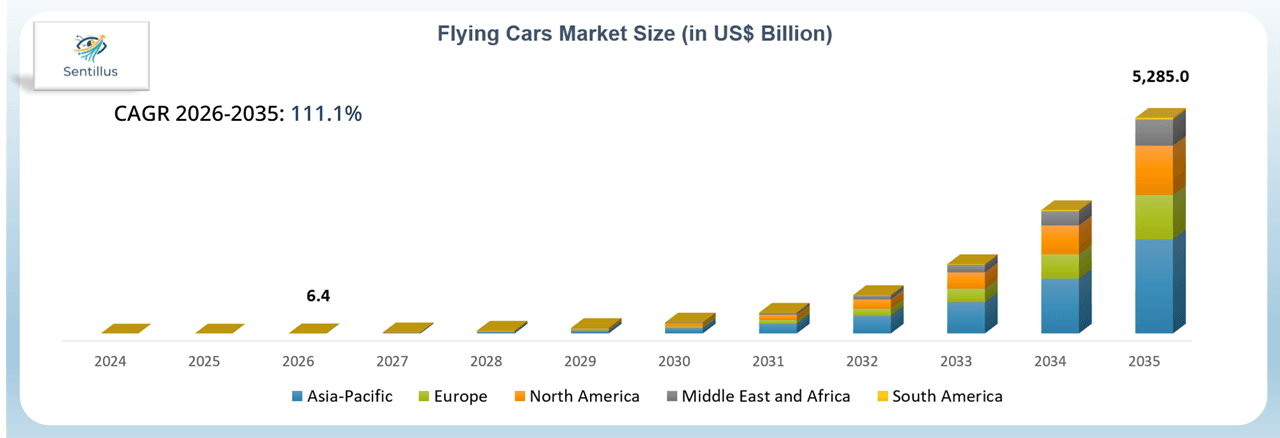
The global flying cars market is projected to expand from US$ 6.4 billion in 2026 to approximately US$ 5.3 trillion by 2035, registering an exceptional CAGR of 111.1% between 2026 and 2035. The extensive growth is a result of both technological progress and the match between aerospace engineering, manufacturing of automobiles, artificial intelligence, aviation infrastructure and supportive regulation of these spheres The spread of commercial applications of flying cars beyond China into other global economic powers will ensure their integration into future transport systems and the total restructuring of how people and cargo move globally.
The market is on the verge of its revolutionary phase as further advancements in technologies of electric propulsion, autonomous flight capabilities, lightweight design and digital aviation infrastructure are bringing the sector from the prototyping stage to actual commercial application. A vision which previously seemed like science fiction is fast becoming a reality, representing a means of transport which could solve many problems of the modern world such as urban traffic, poor connectivity of remote areas, slow reaction time of emergency services and the need for sustainable transport. Differentiating itself from conventional air transport vehicles, modern flying cars are capable of VTOL and are not dependent on any airport facilities because of small operating area.
However, the commercialization timetable has greatly advanced in recent years as aviation regulatory agencies have created specific certification routes for powered-lift air vehicles. The FAA in the United States, the EASA in the European Union, CAAC in China and the JCAB in Japan are collaborating with industry companies to certify next-generation aircraft for commercial applications.
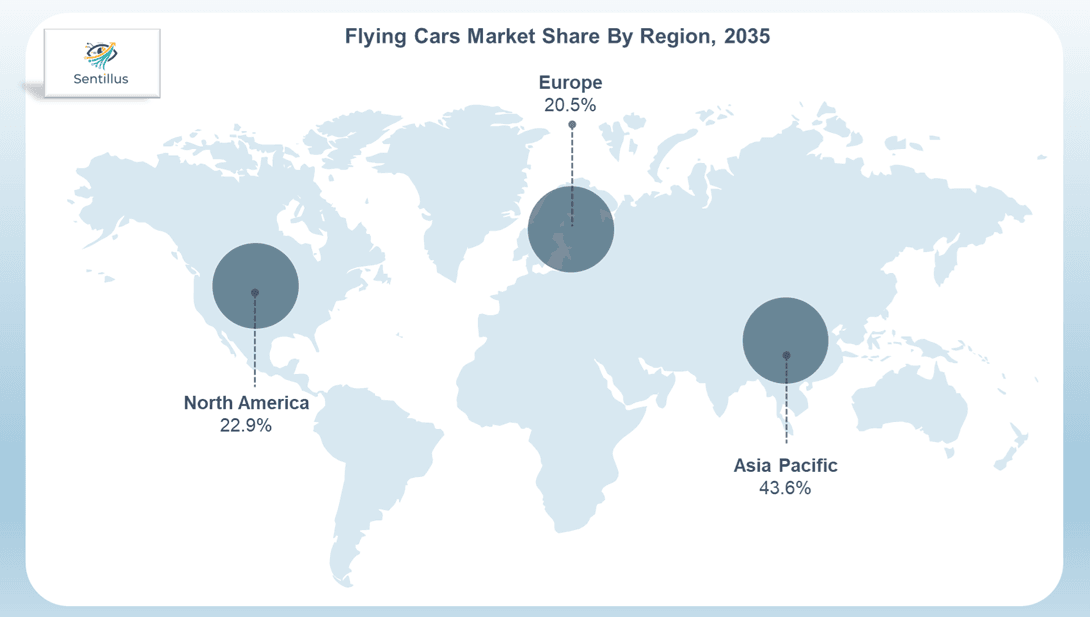
China is the world leader since flying cars is incorporated in its country’s low-altitude transport strategy. China has set up demonstration zones, expedited certification processes, promoted investments in vertiports and facilitated commercial projects that involve passenger transport, logistics, tourism and emergency applications. First mover advantage gives Asia-Pacific as the sole revenue generating region in the initial commercialization phase. As a result, the global flying cars market has reached a valuation of US$ 6.4 billion in 2026, with Asia-Pacific accounting for 100% of the revenue as the first region where commercialized and certified flying cars have been deployed. The gradual expansion of commercialization to North America, Europe and Middle East will diversify regional revenues. In 2035, Asia-Pacific will lead the market with a market share of 43.6%, followed by North Americawith22.9% and Europe with 20.5% market shares.
The growth rate will vary based on the preparedness to regulate the market, manufacturing capability, infrastructure development and governmental policies. China is anticipated to be the largest market in terms of individual markets, contributing up to 26.0% of the global revenue, owing to manufacturing capabilities in the country, infrastructure development by the government and early commercialization. On the other hand, the U.S.is anticipated to contribute 19.0% of global revenue due to FAA certification progress, massive investments from aerospace, technology firms and increasing UAM piloting programs.
India Flying Cars Market is expected to comprise 6.1% of the global market by 2035, driven by increased investments from local startups, associations with research organizations, development of smart cities and government emphasis on next generation transport technologies.
Innovation in technology continues to be the key growth factor. Advancements in battery energy density, are helping increase flight times while decreasing aircraft weight thus helping in making aircraft more economical to operate. Artificial Intelligence is increasing capabilities in autonomous navigation, obstacle detection, prediction, maintenance and fleet management. Digital air traffic management systems are also being developed which can help in integrating flying cars in aviation networks at lower altitudes. Furthermore, there have been rapid advancements in electric engines, distributed lift technologies, fly-by-wire controls and composite structures of aircrafts.
Flying cars offer a three-dimensional mobility solution capable of significantly reducing travel times without requiring extensive investments in new highways or rail corridors. In most urban centers, commuters waste several hundred hours per year due to traffic jams, while emergency services and logistic companies experience growing delays in the delivery of goods and services.
While the biggest long-term potential exists in passenger transportation, commercialization is anticipated to be made in many different sectors. Transport of air taxis, medical emergencies, logistics for cargo, disaster relief, infrastructure inspection, tourism, military and government operations are some examples that are anticipated to add to early revenue realization. From all of the above applications, it is estimated that the market opportunity arising from the use of air taxi passenger transport will amount to US$ 157.1 billion in 2030 and US$ 2.55 trillion in 2035, indicating the significant contribution that it makes in terms of being the main commercial application of flying cars.
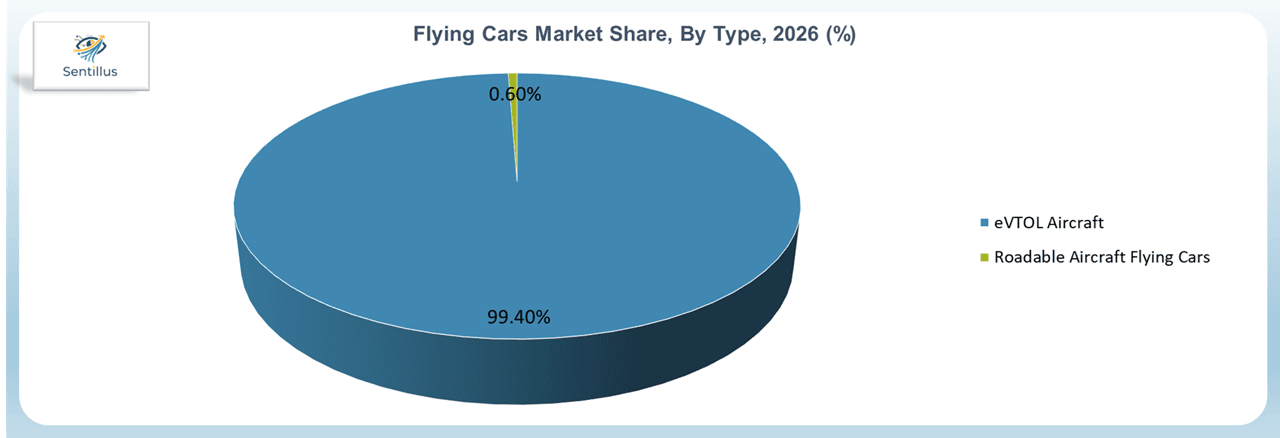
From the technological point of view, the share of eVTOLs will be nearly 100% in the beginning of commercialization period, with total revenues amounting to US$ 6.3 billion in 2026, due to the high degree of maturity and rapid certification process of these technologies, in contrast to roadable vehicles. However, roadable flying cars will have the largest growth rates due to the maturing of the underlying technologies, which will bring revenues to US$ 111.9 billion by 2035 with a CAGR of 142.8%. Also, pilotedaircraft will dominate at the beginning of commercialization with total revenues of US$ 5.2 billion in 2026.
Key Market Takeaways
Dimension
Insight
By type
eVTOL dominates initial commercialization
By application
Air taxi leads long-term opportunity
By region
Asia-Pacific leads commercialization
By propulsion
Electric dominates early market
By certification
Certified aircraft gain first-mover advantage
By production
Scaled production becomes key bottleneck
By company
EHang/Joby/Archer etc.
By infrastructure
Vertiports become critical enabling layer
Market Dynamics
Rapid development in technology and regulations has caused the flying car to evolve from an experimental vehicle into a commercially viable aircraft. In the last ten years, great advances have been made in electric propulsion technologies, battery energy density, lightweight composites, distributed electric propulsion, digital flight control systems and autonomous flight control, which have greatly increased the safety and efficiency of the aircraft. Meanwhile, aviation organizations across the world have developed specific certifications for powered lift vehicles, which has lowered one of the biggest obstacles faced by the industry.
Segment Analysis
By Type: eVTOL Aircraft Segment Dominates the Market Due to Faster Commercial Readiness and Regulatory Progress
The eVTOL aircraftmarket is estimated to bring in around US$ 6.3 billion worth of revenue in 2026, covering almost the entirety of the commercial sector as the certification process starts in China. The roadable flying cars will take longer to commercialize due to their complicated engineering and dual regulation process. However, constant innovation will continue to help them penetrate the market as the Roadable Aircraft Flying Cars market is predicted to achieve around US$ 3.9 billion by 2030, growing at a CAGR of 142.8%. Regardless of this massive growth potential, eVTOL aircraft are likely to serve as the main basis for passenger transport, fleet management, cargo operations, emergency purposes and government use in the coming years due to its better commercialization and regulations processes.
EVTOL aircraft is considered the technology base of the global market for flying cars and is predicted to maintain its leading position during the entire projection period. In contrast to roadable flying cars, which need to be certified in both automotive and aviation sectors, EVTOL aircraft are meant to operate only in the air; therefore, the main goal for the developers is obtaining an aviation certification and faster deployment. The benefits of the simplified design, distributed electric power plant, reduced maintenance needs and compatibility with the emerging vertiports infrastructure made them more preferable than other vehicle types for many companies and governments’ AAM programs.
By Application: Air Taxi Passenger Transport Emerges as the Primary Revenue Generator
The Air Taxi Passenger Transport is projected to create a market opportunity of US$ 157.1 billion by 2030, expanding to nearly US$ 2.55 trillion by 2035. The growth is attributed to growing commercial implementations in Asia-Pacific, North America and Europe through improved certification, vertiport developments, increased customer acceptance and reduced cost of operations of aircrafts. As cities increasingly integrate Advanced Air Mobility into multimodal transportation planning, passenger air taxi services are expected to become the cornerstone application driving long-term growth across the global flying cars market.
Air taxi passenger transport is expected to become the largest application within the flying cars market as governments, aircraft manufacturers, infrastructure developers and mobility operators increasingly prioritize urban and regional passenger transportation. The segment directly addresses one of the most significant global transportation challenges-rapidly increasing travel demand within densely populated metropolitan areas where conventional road infrastructure is approaching practical capacity limits. By enabling direct point-to-point travel above congested road networks, flying cars can significantly reduce journey times while offering a premium mobility alternative for both business and personal travel.
While cargo transportation, medical evacuation, disaster response, tourism and defense applications will contribute meaningful revenue during the industry’s early years, passenger transportation is expected to remain the largest long-term revenue opportunity because of its significantly larger addressable market and higher fleet deployment potential.
U.S. is expected to account for 19% share of overall flying cars revenues in the world by 2035 and to be the second largest market in the world after China. Its regulatory improvements, infrastructure developments and commercialization by domestic firms will position it among the pioneers in aerial mobility innovations.
USA well-developed aerospace ecosystem, substantial investments from venture capitalists, progressive regulations in aviation, as well as one of the largest innovative networks in urban air mobility are among reasons for this forecast. The U.S. will lag behind China in the commercialization process, but it has significant advantages due to its experience in aircraft production, high-quality digital infrastructure, experienced aviation staff and good cooperation of regulators and businesses.
One of the leading contributors to commercialization efforts is the Federal Aviation Administration (FAA), which has introduced the Innovate28 program to develop the basis for the introduction of Advanced Air Mobility into the National Airspace System by the 2028 Los Angeles Olympic Games. At the same time, the U.S. Department of Transportation supports pilot projects for introducing the technology that will enable manufacturers to prove their operational procedures, vertiport design, emergency management and other aspects of their performance.
The United States possesses some of the world-renowned companies in the area of Advanced Air Mobility, including Joby Aviation, Archer Aviation, Beta Technologies, Boeing, Wisk Aero, Electra.aero and many other software providers. All these firms have secured billions of dollars of investments from investors and created manufacturing sites for the future commercialization of these technologies. Collaborations with airlines, airports, rideshare services and infrastructure developers are creating an ecosystem of technologies going beyond simple airplane manufacturing to include charging stations, online booking systems, maintenance network and more.
Initial commercial need will most likely come from high population centers like New York, Los Angeles, Dallas, Miami, San Francisco and Chicago, whose airports, commercial transportation, tourism and regional movement hold a lot of economic value. In addition, medical emergencies, disasters, military operations and cargo transport are other areas that can yield some early commercial income prior to general consumer adoption.
Japan Flying Cars Market Analysis
Japan is one of the early adopters of flying cars due to its government policy that supports advanced air mobility (AAM). It is known that Japan has advanced aerospace engineering capacity and also aims at solving urban and regional connectivity problems. Japan stands out from other countries in terms of the way the process of commercialization is carried out, with government agencies, aviation regulators, car manufacturers, tech firms and educational institutions collaborating in the process. As a result, the development process of such innovations is much faster.
The main growth driver is the aging population and lack of workers in the rural areas. It becomes difficult for people to access transportation means in the areas that suffer from the decline of public transportation and have difficult terrain. Flying cars can be used for reaching the islands and remote areas where it becomes difficult to construct the traditional transportation system. Aircraft will not only be useful for passenger transportation but also for emergency services, tourism and logistics.
The domestic firms keep on reinforcing Japan’s competitive advantage. SkyDrive has successfully carried out several tests of flights while simultaneously making efforts toward certifying its mini eVTOL vehicle. Several automobile giants such as Honda and Toyota have made investments in the technology of advanced air mobility, which illustrates the gradual convergence of the auto industry and aerospace industry. Such manufacturing skills will facilitate mass production in the future.
India Flying Cars Market Analysis
India is projected to become one of the fastest-growing markets of flying cars, due to its urbanization growth, technological progress, government support of modern transportation solutions and the growth of domestic aerospace businesses. Despite the fact that flying car commercialization will start later compared to that in China, India still possesses significant potential for growth in the future, taking into account its large number of urban inhabitants, growth of disposable incomes, investments in smart cities and the growing need for effective means of transportation.
Traffic congestion is among the main problems of transportation in India. Such large cities as Delhi, Mumbai, Bengaluru, Hyderabad, Chennai and Pune are heavily congested, leading to increased time of traveling, fuel use, logistics costs and pollution. Modern transport systems would not be enough to meet the future needs because of the increasing number of urban residents. Flying cars might turn out to be a new level of mobility that can help solve traffic problems.
Government schemes are making positive impacts towards improving the future prospects of the sector, including Make in India, Digital India, Smart Cities Mission and National Logistics Policy programs that are motivating investments for the development of modern transport infrastructure and manufacturing. On the other hand, DGCA is partnering with Indian inventors to create a regulatory framework for future eVTOL certification and operations.
India has emerged to be one of the most promising markets when it comes to startups in the flying cars market. It includes companies such as The ePlane Company, Sarla Aviation, Vinata Aeromobility and some research organizations that are involved in designing indigenous aircraft technologies related to urban air mobility, EMS and regional connectivity solutions. Many academic partnerships happened recently involving IIT Madras and other institutions specializing in engineering.
India also offers long-term manufacturing advantages because of its competitive labor costs, expanding aerospace supply chain and established automotive manufacturing ecosystem. Global aircraft manufacturers are increasingly evaluating India as a future manufacturing and engineering hub for advanced air mobility components, software development and digital engineering services. The growing digitization in India also acts as enabler for adoption of flying cars. Usage of smartphones, digital payments systems, AI-powered mobility solutions, cloud computing and 5G are some technological enablers which make India a suitable place for management of fleet, booking of passengers, maintenance services and autonomous flight.
According to reports by Sentillus, by 2035 India is expected to contribute around 6.1% share in the global flying cars market. With further growth in indigenous technology development, regulatory framework and infrastructure in urban mobility, India would become a hub for flying cars’ manufacturing and deployment.
UAE Flying Cars Market Analysis
As part of the long-term strategy in smart cities and economy diversification, the United Arab Emirates have become among the most progressive markets for flying cars through the inclusion of Advanced Air Mobility. In contrast to bigger markets characterized mainly by large population, the competitive edge of the UAE is determined by active governmental policy, quick decision-making process in regulation, advanced infrastructure and readiness to embrace new means of transportations. All this makes UAE one of the first countries outside Asia which can implement commercial flying cars.
Dubai and Abu Dhabi governments always actively invested in intelligent transport systems, autonomous mobility, artificial intelligence and digital infrastructure development. Aerial mobility was officially recognized by governmental institutions as a part of the future transport system and there were several pilot projects launched that involve leading international aircraft manufacturers and infrastructure providers. Small size of the country’s territory and concentration of commercial activities positively affect the feasibility of premium air taxis.
Every year, many millions of international tourists visit UAE, due to its scenic beauty, several international expositions, conferences and sporting events. Flying cars could be used to offer premium airport transfers, sightseeing tours, luxurious tourism experience and fast business transportation from the business centers, hotels, airports and entertainment zones. The areas require a greater revenue per capita than usual public transportation, thus, increasing the efficiency of flying car fleet at the stage of the initial commercialization of the industry.
The UAE also became an ideal place for testing new technologies, as its regulatory policy is very flexible. Cooperation of airplane manufacturers, aviation organizations, airports and technology developers helps to speed up commercial testing and gather information necessary for further expansion to other regions. UAE advantages position makes it the Middle East’s leading flying cars market and an important gateway for commercial deployment across the wider Gulf region.
Key Developments
Company
Strategy
Month & Year
Development
Joby Aviation
Certification
March 2026
Joby Aviation Conducted the successful first flight of its FAA-conforming production-intent electric air taxi, marking a major milestone toward FAA Type Inspection Authorization (TIA). The aircraft features six tilt rotors and is designed to carry one pilot and four passengers for commercial urban air mobility operations.
Boeing
Product Launch
March 2026
Introduced its Generation 6 autonomous four-passenger eVTOL air taxi, designed for self-flying urban transportation. The new platform incorporates autonomous flight technologies and supports Boeing’s strategy to advance passenger eVTOL certification and commercialization.
Archer Aviation Inc.
Government Partnership & Expansion
March 2026
Selected for the U.S. Department of Transportation’s eVTOL Integration Pilot Program (eIPP). Archer will conduct pilot operations across Texas, Florida and New York to accelerate real-world deployment and support future FAA regulations for commercial air taxi services.
SAMSON SKY, LLC
Partnership
March 2026
Signed a Memorandum of Understanding (MoU) with the Government of Tajikistan to support flying car regulations, pilot training programs and the planned sale of 50 Switchblade Flying Car units, expanding its international market presence.
XPeng AeroHT (XPeng Inc.)
Manufacturing Expansion
January 2026
Began test production at its approximately 10,000-unit annual capacity manufacturing facility while advancing IPO preparations and targeting first customer deliveries in late 2026, marking a significant step toward mass production of consumer flying cars.
Horizon Aircraft
Product Launch
January 2026
Announced major design upgrades for the Cavorite X7 hybrid-electric eVTOL, including a 12-lift-fan configuration, enhanced aerodynamics, an extended passenger cabin and improved operational efficiency to strengthen certification readiness and commercial competitiveness.
Volocopter GmbH
Certification & Product Launch
January 2026
Advanced certification activities for both the VoloXPro light-sport eVTOL and the VoloCity passenger air taxi while optimizing its supply chain to accelerate commercialization of urban air mobility services.
Eve Holding, Inc.
Certification
December 2025
Successfully completed the maiden flight of its eVTOL prototype, validating propulsion, flight-by-wire systems and aircraft architecture. The milestone initiated an expanded flight-test campaign supporting certification and commercial entry into service.
Vertical Aerospace Ltd.
Product Launch
December 2025
Launched the Valo eVTOL flying taxi, designed for passenger transport, cargo logistics and emergency response missions. The aircraft incorporates advanced fly-by-wire controls and enhanced safety technologies to improve urban mobility efficiency.
EHang Holdings Limited
Partnership and Geographic Expansion
December 2025
Collaborated with the Government of Thailand and aviation authorities to accelerate the development of an urban air mobility ecosystem, including regulatory frameworks, infrastructure development and deployment of autonomous air taxis across Southeast Asia.
EHang Holdings Limited
Product Launch
October 2025
Unveiled the VT-35 next-generation autonomous flying taxi, featuring extended range capabilities for intercity and regional travel while integrating with the existing EH216-S ecosystem to expand scalable advanced air mobility operations.
BCG Matrix
Company
BCG Position
Assessment
EHang Holdings Limited
Star
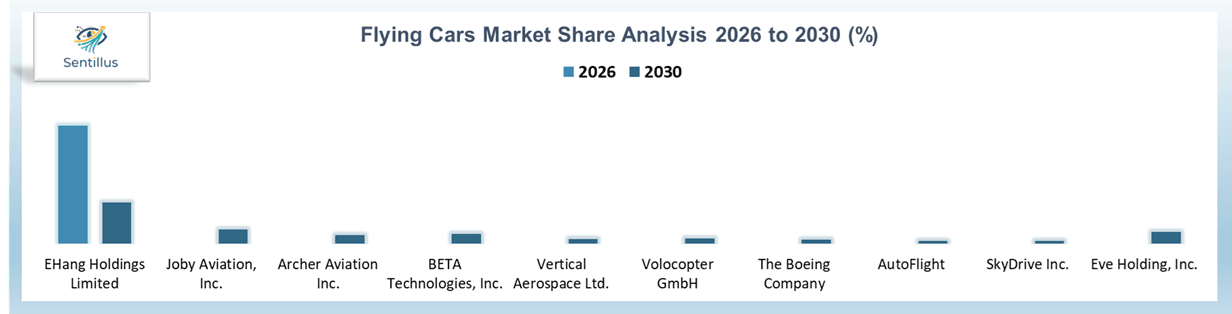
EHang has established the strongest first-mover advantage through commercial deployment in China, certified autonomous passenger aircraft and government-backed low-altitude economy initiatives. Its early commercialization and expanding ecosystem position it as the current market leader.
Joby Aviation
Star
Joby continues advancing FAA certification, production-scale manufacturing and commercial partnerships with airlines and infrastructure providers. Strong technological capabilities and regulatory progress make it one of the industry’s highest-growth companies.
Archer Aviation
Star
Archer is rapidly expanding through strategic partnerships, government-supported pilot programs, manufacturing investments and commercialization initiatives focused on urban air taxi operations across the United States.
XPeng AeroHT
Question Mark
XPeng possesses strong manufacturing expertise and financial resources but remains in the early commercialization phase for consumer-oriented flying cars. Future market leadership depends on successful production scale-up and regulatory approvals.
Volocopter GmbH
Question Mark
Volocopter maintains strong certification progress and urban air mobility partnerships across Europe and the Middle East; however, delayed commercialization limits current market share despite high future growth potential.
Vertical Aerospace Ltd.
Question Mark
The company continues advancing aircraft development and certification while strengthening strategic collaborations. Commercial execution and certification timelines will determine future competitive positioning.
SkyDrive Inc.
Question Mark
Supported by Japan’s advanced mobility initiatives, SkyDrive demonstrates strong innovation but remains at an earlier commercialization stage compared with global leaders.
Boeing
Cash Cow
Boeing possesses extensive aerospace expertise, engineering resources and manufacturing capabilities. Although flying cars currently contribute a limited share of revenue, its financial strength enables continued investment in next-generation aerial mobility.
Airbus
Cash Cow
Airbus leverages decades of commercial aviation expertise and R&D capabilities to support long-term Advanced Air Mobility initiatives while maintaining a stable global aerospace business.
Lilium GmbH
Dog
Despite innovative aircraft concepts, prolonged certification timelines and commercialization challenges have limited market penetration relative to faster-moving competitors.
Industry Trends
autonomous flight
battery density
vertiport networks
air traffic digitization
certification standardization
fleet-as-a-service
AI flight management
urban mobility integration
Disruption Analysis
Flying cars are poised to become one of the most revolutionary transportation innovations in terms of their impact on the transportation sector in the coming decade as they revolutionize movement of both passengers and cargo in urban and regional settings. In contrast to incremental changes to current transport systems, flying cars bring about a whole new mobility layer that takes advantage of airspace at low altitudes.
The greatest disruption in the industry will take place in urban transportation where businessmen, high-end commuting individuals, as well as emergency and logistical services, are in need of faster travel times than conventional roads allow. Flying cars are able to shorten travel times up to two-thirds on many urban routes compared to regular helicopters.
In addition, there will be a disruption within the aviation industry itself. While conventional helicopters have long ruled over short-haul air transport, electric aircraft are cheaper to operate and maintain, less noisy and produce no emissions at all. Furthermore, electric aircraft provide better operating economics and greater business possibilities compared to helicopters in congested urban centers where noise pollution is a major issue.
Commercial Use Cases
Application
Current Adoption
Commercial Potential
Key Companies
Air Taxi
Emerging
Very High
…
Cargo
Emerging
High
…
Medical
Emerging
High
…
Tourism
Pilot
Medium/High
…
Emergency
Pilot
High
…
Defense
Emerging
High
…
Infrastructure Inspection
Emerging
Medium
…
Market Scope
Metrics
Details
2026 Market Size
US$ 6.4 Billion
2035 Projected Market Size
US$ 5,285.0 Billion
CAGR (2026-2035)
111.1%
Largest Market
Asia-Pacific, US$ 2.3 Trillion by 2035
Fastest Growing Market
Middle East and Africa, 85.5% CAGR
By Type
eVTOL Aircraft
Roadable Aircraft Flying Cars
By Mode of Operation
Piloted
Autonomous
Semi-Autonomous
By Seating Capacity
Single Seater
Two Seater
Three to Four Seater
Five to Six Seater
More than Six Seater
By Lift Technology Architecture
Multirotor
Lift & Cruise
Tiltrotor
Tiltwing
Ducted Fan
Hybrid Configurations
By Propulsion Type
Fully Electric
Hybrid Electric
Hydrogen Fuel Cell
By Range
Short Range (<50 km)
Medium Range (50-150 km)
Long Range (>150 km)
By Maximum Take-Off Weight (MTOW)
Less than 1,000 kg
1,000-2,000 kg
More than 2,000 kg
By Battery Capacity (kWh Bands)
Below 100 kWh
100-200 kWh
200-350 kWh
350-500 kWh
Above 500 kWh
By Certification Status
Prototype (Flight Testing Phase)
Pre-Certification (Type Certification in Progress)
Certified (Type Certified Aircraft)
Commercial Operations Approved
By Production Capacity Level (Annual Units)
R&D & Prototype Only (<10 units per year)
Low-Rate Initial Production (10-100 units per year)
Scaled Production (100-500 units per year)
Mass Production (>500 units per year)
By Cruise Speed
Below 150 km per hour
150 to 250 km per hour
Above 250 km per hour
By Charging Infrastructure
Battery Electric Charging
Hydrogen Refueling
Hybrid Fuel Systems
By Ownership Model
Fleet Based Operations
Private Ownership
Government Procurement
By Aircraft Price (ASP Band)
Below US$ 1.5 Billion
US$ 1.5 – 3 Billion
US$ 3 – 5 Billion
Above US$ 5 Billion
By Application
Air Taxi Passenger Transport
Cargo and Logistics
Defense and Military
Medical Evacuation Air Ambulance
Personal Mobility
Tourism and Leisure Flights
By End-User
Commercial Operators
Fleet Aggregators
Government & Defense
Emergency Services
Private Owners
By Region
North America
U.S., Canada, Mexico
Europe
Germany, UK, France, Italy, Spain, Netherlands
Asia-Pacific
China, India, Japan, Australia, South Korea, Indonesia, Malaysia, Philippines, Singapore, Thailand, Vietnam
Expanding PFAS and Environmental Monitoring Requirements
Tightening Food and Environmental Testing Requirements Expand the Need for Matrix-Specific CRMs
Restraints
Impact Analysis - Drivers and Restraints
Opportunity
Biotechnology and Advanced Healthcare Testing Create a High-Growth Opportunity for Specialized CRMs
Digital CRMs Could Transform Reference Material Accessibility and Long-Term Analytical Traceability
Semiconductor and Advanced Materials Manufacturing Creates New High-Purity CRM Requirements
Trends
Challenges
Industry Analysis
Porter's Five Force Analysis
PESTEL Analysis
Geopolitical Analysis
Supply/Value Chain Analysis
Pricing Analysis
Regulatory Analysis
Innovation and R&D Trends
Sustainability and ESG Analysis
Risk Avoidance Model
Go-To-Market (GTM) Strategy
BCG Matrix
Tariff Analysis
Trade Policies Influencing The Market
Cost Impact Factors
Supply Chain Disruptions
Trade Analysis
Export
Import
Trade Gap
Trade Opportunities
Business Models Analysis
Demand-Supply Gap
Risk Mitigation Framework
Compliance Roadmap
Strategic Implications
Emerging Opportunities
Adoption Trends
Disruption Analysis
Analyst Opinion
By Product
Introduction
Market Size(USD Billion), Y-o-Y Growth (%), CAGR (%) and Analysis, By Product
Market Attractiveness Index, By Product
Organic
Inorganic
By Application
Introduction
Market Size(USD Billion), Y-o-Y Growth (%), CAGR (%) and Analysis, By Application
Market Attractiveness Index, By Application
Quality Control & Assurance
Method Validation
Regulatory Compliance Testing
R&D & Analytical Development
Calibration & Instrument Validation
By End-User
Introduction
Market Size(USD Billion), Y-o-Y Growth (%), CAGR (%) and Analysis, By End-User
Market Attractiveness Index, By End-User
Consumer Industry
Contract Testing
University / Non-Profit
Energy Industry
Environmental Testing
Healthcare
Industrial / Manufacturing
Materials / Mining
By Region
Introduction
Market Size (USD Billion), Y-o-Y Growth (%), CAGR (%) and Analysis, By Region
Market Attractiveness Index, By Region
North America
Introduction
Key Region-Specific Dynamics
Market Size (USD Billion), Y-o-Y Growth (%), CAGR (%) and Analysis, By Product
Market Size (USD Billion), Y-o-Y Growth (%), CAGR (%) and Analysis, By Application
Market Size (USD Billion), Y-o-Y Growth (%), CAGR (%) and Analysis, By End-User
Market Size (USD Billion), Y-o-Y Growth (%), CAGR (%) and Analysis, By Country
U.S.
Canada
Mexico
Asia-Pacific
Introduction
Key Region-Specific Dynamics
Market Size (USD Billion), Y-o-Y Growth (%), CAGR (%) and Analysis, By Product
Market Size (USD Billion), Y-o-Y Growth (%), CAGR (%) and Analysis, By Application
Market Size (USD Billion), Y-o-Y Growth (%), CAGR (%) and Analysis, By End-User
Market Size (USD Billion), Y-o-Y Growth (%), CAGR (%) and Analysis, By Country
China
India
Japan
Australia
South Korea
Indonesia
Malaysia
Philippines
Thailand
Vietnam
Rest of Asia-Pacific
Europe
Introduction
Key Region-Specific Dynamics
Market Size (USD Billion), Y-o-Y Growth (%), CAGR (%) and Analysis, By Product
Market Size (USD Billion), Y-o-Y Growth (%), CAGR (%) and Analysis, By Application
Market Size (USD Billion), Y-o-Y Growth (%), CAGR (%) and Analysis, By End-User
Market Size (USD Billion), Y-o-Y Growth (%), CAGR (%) and Analysis, By Country
Germany
UK
France
Italy
Spain
Netherlands
Rest of Europe
South America
Introduction
Key Region-Specific Dynamics
Market Size (USD Billion), Y-o-Y Growth (%), CAGR (%) and Analysis, By Product
Market Size (USD Billion), Y-o-Y Growth (%), CAGR (%) and Analysis, By Application
Market Size (USD Billion), Y-o-Y Growth (%), CAGR (%) and Analysis, By End-User
Market Size (USD Billion), Y-o-Y Growth (%), CAGR (%) and Analysis, By Country
Brazil
Argentina
Rest of South America
Middle East and Africa
Introduction
Key Region-Specific Dynamics
Market Size (USD Billion), Y-o-Y Growth (%), CAGR (%) and Analysis, By Product
Market Size (USD Billion), Y-o-Y Growth (%), CAGR (%) and Analysis, By Application
Market Size (USD Billion), Y-o-Y Growth (%), CAGR (%) and Analysis, By End-User
Market Size (USD Billion), Y-o-Y Growth (%), CAGR (%) and Analysis, By Country
UAE
Saudi Arabia
South Africa
Nigeria
Rest of Middle East and Africa
Competitive Landscape
Competitive Scenario
Market Share Analysis 2025 - Global
Mergers and Acquisitions Analysis
Partner Identification Analysis
Investment & Funding Landscape
Strategic Alliances & Innovation Pipeline
Company Profiles
Merck KGaA
Company Overview
Product Portfolio and Description
Revenue Analysis
Pricing Analysis
SWOT Analysis
Recent Developments
Major Deals
Expansion
Merger and Acquisition
Collaboration
Product Launches
Joint Ventures
Partnerships
Innovations
Recent News
Events
Conferences
Symposiums
Webinars
LGC Limited
Antylia Scientific
Agilent Technologies, Inc.
CPAChem
Inorganic Ventures
AccuStandard
AnalytiChem Holding GmbH
Starna Scientific Limited
FLUXANA GmbH & Co. KG
Alpha Resources LLC
Appendix
About Us and Services
Contact Us
Who Should Buy This Report in 2026?
The Sentillus Flying Cars Market Report (2026 Edition) is designed for organizations involved in the development, investment, regulation, manufacturing, deployment or adoption of Advanced Air Mobility technologies.
Assess opportunities for diversification into aerial mobility, identify strategic partnerships, evaluate manufacturing opportunities and understand future mobility business models.
Battery, Electronics and Component Suppliers
Analyze future demand for electric propulsion systems, batteries, semiconductors, sensors, avionics, lightweight materials and advanced manufacturing technologies supporting flying car production.
Government Agencies and Aviation Regulators
Understand global commercialization trends, certification developments, infrastructure requirements and policy initiatives supporting Advanced Air Mobility deployment.
Infrastructure Developers and Airport Operators
Evaluate opportunities related to vertiports, charging infrastructure, maintenance facilities, multimodal transportation integration and airport connectivity.
Venture Capital and Private Equity Firms
Identify high-growth technology developers, evaluate investment opportunities, benchmark competitive positioning and assess long-term commercialization potential across different market segments.
Airlines and Mobility Service Providers
Develop future fleet strategies, evaluate operational business models, understand passenger demand trends and identify opportunities within urban air taxi and regional mobility services.
Defense and Public Safety Organizations
Assess applications related to emergency response, disaster management, surveillance, border security, medical evacuation and government transportation.
Research Institutions and Universities
Support technology development, policy research, battery innovation, autonomous flight systems, urban planning and next-generation aerospace engineering initiatives.
Strategy Consultants and Corporate Planning Teams
Leverage independent market intelligence for strategic planning, competitive benchmarking, investment evaluation, partnership identification and long-term business expansion within the rapidly evolving flying cars ecosystem.
Methodology
How Sentillus develops the Flying Cars Market research report
Sentillus develops the Flying Cars Market research report through a documented methodology combining primary research, secondary research, market sizing, competitive landscape analysis, forecasting, and multi-stage data validation.
Market-specific research focus
For the Flying Cars Market, the research framework is adapted to the relevant industry structure, market participants, geographic coverage, data availability, regulatory environment, and commercial dynamics.
01
Industry intelligence
Primary Research
Primary research sources include:
Manufacturers
Raw material suppliers
Distributors
Technology providers
Industry consultants
Regulatory experts
Business executives
Procurement professionals
Channel partners
Other industry stakeholders
Information collected through primary research includes:
Market dynamics
Demand patterns
Supply conditions
Pricing trends
Customer adoption
Technology developments
Competitive positioning
Future business outlook
Primary research is used as a validation layer and is not treated as the sole source of market conclusions.
02
Evidence base
Secondary Research
Secondary research sources include:
Government publications
Regulatory authorities
Customs and trade databases
Company annual reports
Investor presentations
SEC and exchange filings
Industry associations
Technical publications
White papers
Patent databases
Corporate press releases
Academic publications
International organizations
Information gathered through secondary research includes:
Industry structure
Company activities
Production trends
Trade flows
Regulatory developments
Technology evolution
Investment activity
Market segmentation
Multiple independent sources are compared to improve consistency and reduce dependence on any single source.
03
Quality control
Evidence Collection & Data Validation
Validation process for the Flying Cars Market includes:
Cross-source verification
Timeline verification
Geographic verification
Company confirmation
Regulatory confirmation
Internal consistency checks
04
Market measurement
Market Size Estimation
Market estimation approaches include:
Bottom-up analysis
Top-down analysis
Company-level assessment
Industry benchmarking
Regional validation
05
Future outlook
Forecasting Methodology
Forecast inputs for the Flying Cars Market include:
Technology adoption
Industry investments
Regulatory developments
Capacity expansion
Supply-chain developments
Trade activity
Consumer demand
Industrial demand
Competitive dynamics
Macroeconomic conditions
06
Market structure
Competitive Landscape
The competitive assessment evaluates:
Company mapping
Product and service portfolios
Geographic presence
Production and distribution footprint
Competitive positioning
Strategic developments
07
Participant analysis
Company Mapping Framework
Manufacturers
Technology developers
Raw material suppliers
Equipment providers
Service providers
Distribution partners
Regional participants
Global participants
08
Geographic analysis
Regional Research Framework
Industrial activity
Manufacturing capacity
Trade patterns
Regulatory environment
Investment activity
Technology adoption
Country-level developments
09
Compliance environment
Regulatory Research
Government legislation
Industry standards
Certification requirements
Compliance frameworks
Policy updates
Regulatory guidance
10
Final assurance
Editorial Review & Quality Controls
Data consistency
Structural accuracy
Terminology consistency
Duplicate content checks
Internal linking
Editorial quality
SEO optimization
Readability
11
Market-specific framework
Research Transparency & Adaptive Methodology
Sentillus applies a transparent and adaptive methodology so research methods can be adjusted to the Flying Cars Market, geography, data availability, industry structure, and research objective while maintaining documented validation and editorial quality controls.
Multi-stage research validation
Primary research, secondary evidence, market analysis, competitive assessment, forecasting, and editorial review are combined to improve consistency and research transparency.
Frequently Asked Questions
Each Sentillus report provides comprehensive market analysis, market segmentation, company profiles, competitive benchmarking, regional insights, market trends and strategic recommendations designed to support informed business decisions.
Yes. Sentillus provides customized research based on geography, market segments, company analysis, technology assessment and specific business requirements.
Reports are delivered in Excel and PDF format, electronically after order confirmation. Delivery timelines may vary depending on customization requirements.
Yes. Select the Request Sample option available on the report page and our research team will share the sample shortly.
Yes. The PDF report includes competitive landscape analysis, company profiling, strategic developments and market share analysis of major participants. Excel includes market share analysis of major participants.
Yes. Our research analysts are available to clarify report findings and discuss customization requirements.
Why Choose Sentillus?
Decision-Oriented Research
Sentillus delivers research designed for business decisions rather than information collection. Every study combines industry expertise, strategic analysis and practical market intelligence supporting investment, expansion and competitive planning.
Reliable Primary and Secondary Validation
Research integrates interviews with industry participants, public company disclosures, government publications, trade associations, paid databases and verified industrial databases to improve analytical reliability.
Consultant-Level Industry Analysis
Every report explains why market changes occur, how competitive dynamics evolve and which developments create future business opportunities rather than simply presenting historical information.
Customized Business Intelligence
Clients receive research tailored to strategic priorities including market entry assessment, competitive benchmarking, supplier evaluation, investment opportunity analysis, pricing assessment and technology landscape studies.
Practical Competitive Insights
Competitive evaluation extends beyond company profiles by examining manufacturing capabilities, expansion strategies, product positioning, innovation priorities and strategic partnerships influencing industry leadership.
Comprehensive Regional Coverage
Country-level analysis evaluates industrial development, manufacturing capacity, production and yield, infrastructure investment, regulatory changes, trade activity and demand outlook across major global markets.
Continuous Research Support
Consultant assistance helps clients interpret findings, clarify market developments and understand industry trends after report delivery, ensuring greater value throughout the decision-making process.
High-Quality Research Standards
Every report follows a structured research methodology emphasizing data accuracy, logical analysis, clear business communication and actionable recommendations suitable for executives, investors and strategy planning teams.
Contains information related to marketing campaigns of the user. These are shared with Google AdWords / Google Ads when the Google Ads and Google Analytics accounts are linked together.
90 days
__utma
ID used to identify users and sessions
2 years after last activity
__utmt
Used to monitor number of Google Analytics server requests
10 minutes
__utmb
Used to distinguish new sessions and visits. This cookie is set when the GA.js javascript library is loaded and there is no existing __utmb cookie. The cookie is updated every time data is sent to the Google Analytics server.
30 minutes after last activity
__utmc
Used only with old Urchin versions of Google Analytics and not with GA.js. Was used to distinguish between new sessions and visits at the end of a session.
End of session (browser)
__utmz
Contains information about the traffic source or campaign that directed user to the website. The cookie is set when the GA.js javascript is loaded and updated when data is sent to the Google Anaytics server
6 months after last activity
__utmv
Contains custom information set by the web developer via the _setCustomVar method in Google Analytics. This cookie is updated every time new data is sent to the Google Analytics server.
2 years after last activity
__utmx
Used to determine whether a user is included in an A / B or Multivariate test.
18 months
_ga
ID used to identify users
2 years
_gali
Used by Google Analytics to determine which links on a page are being clicked
30 seconds
_ga_
ID used to identify users
2 years
_gid
ID used to identify users for 24 hours after last activity
24 hours
_gat
Used to monitor number of Google Analytics server requests when using Google Tag Manager
1 minute
SourceBuster is used by WooCommerce for order attribution based on user source.
Name
Description
Duration
sbjs_session
The number of page views in this session and the current page path
30 minutes
sbjs_udata
Information about the visitor’s user agent, such as IP, the browser, and the device type
session
sbjs_first
Traffic origin information for the visitor’s first visit to your store (only applicable if the visitor returns before the session expires)
session
sbjs_current
Traffic origin information for the visitor’s current visit to your store
session
sbjs_first_add
Timestamp, referring URL, and entry page for your visitor’s first visit to your store (only applicable if the visitor returns before the session expires)
session
sbjs_current_add
Timestamp, referring URL, and entry page for your visitor’s current visit to your store
session
sbjs_migrations
Technical data to help with migrations between different versions of the tracking feature


 Key Inputs