
 Market Overview
 Market Overview
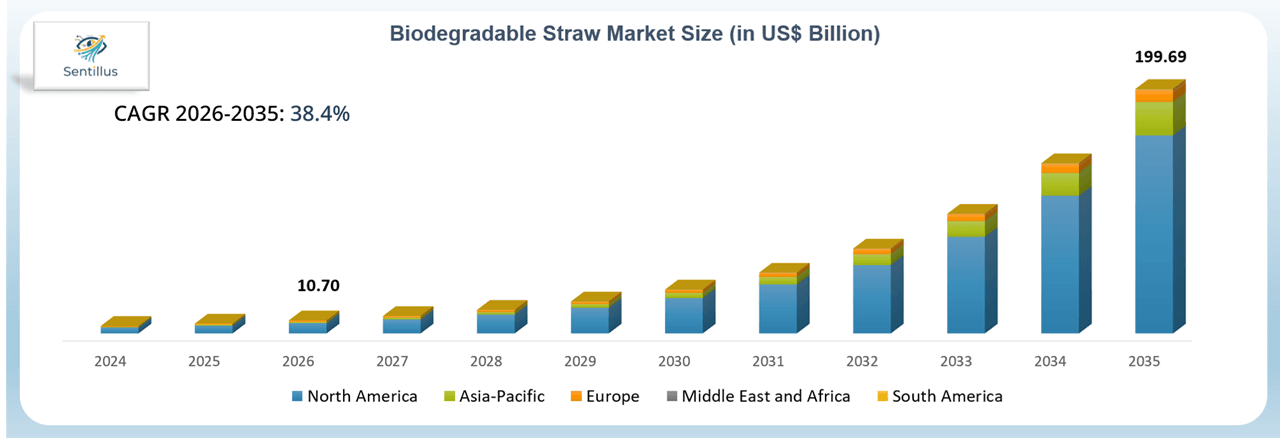
The global biodegradable straws market is moving from a predominantly paper-based response to single-use plastic restrictions toward a broader materials market involving paper, agricultural fibres, pasta, polylactic acid and polyhydroxyalkanoates. Regulatory intervention created the initial substitution cycle while foodservice procurement, beverage innovation and improvements in biodegradable polymers are beginning to determine the next phase of market development. Sentillus estimates global biodegradable straw consumption value at USD 10,699.75 million in 2026, increasing to USD 199,693.67 million by 2035 at a CAGR of 38.4%.
Biodegradable straw prices vary substantially by material, diameter, length, wrapping format, order quantity and certification.
Paper remains overwhelmingly dominant within the current product structure. Paper straw consumption value reaches USD 9,936.26 million in 2026, representing approximately 92.9% of global biodegradable straw value. Existing converting technology, established food-contact supply chains and rapid deployment following restrictions on conventional plastic straws have allowed paper to commercialize considerably earlier than most alternative materials. Competitive dynamics are nevertheless changing because restaurants and consumers continue demanding better wet strength, mouthfeel and durability while regulators increasingly scrutinize coatings and material composition rather than accepting sustainability claims solely because a product contains renewable feedstock.
PHA represents a very different stage of commercialization. PHA straw consumption value is estimated at only USD 140.88 million during 2026 but reaches USD 8,016.85 million by 2035, corresponding to the fastest type-level CAGR of 56.7%. PLA follows with a 53.5% CAGR while pasta straws advance at 45.7%. Such trajectories imply progressive diversification away from paper rather than the disappearance of paper itself. European Bioplastics reports global biobased plastics production capacity of 2.31 million tonnes in 2025 with approximately 1.67 million tons produced, equivalent to average utilization of 72%. Capacity is projected to reach approximately 4.69 million tons by 2030 while PHA and PLA are among the polymers expected to contribute to future expansion.
Foodservice is the commercial centre of biodegradable straw consumption. Cafes and fast-food outlets represent the largest end-user category at USD 5,334.21 million in 2026, followed by bars and restaurants at USD 4,004.66 million. Cafes and fast-food outlets are forecast to reach USD 103,028.00 million by 2035 at a CAGR of 38.9%. High beverage throughput makes the channel particularly important because even modest changes in per-outlet straw procurement multiply rapidly across international restaurant networks. The U.S. restaurant industry alone is projected by the National Restaurant Association to generate USD 1.55 trillion in sales during 2026 while employing approximately 15.8 million people. Such downstream scale provides an independent demand indicator supporting substantial disposable beverage-accessory consumption without using the biodegradable straw market estimate as its own evidence.
Regional concentration remains exceptionally high. North America accounts for an estimated USD 8,534.90 million in 2026 and reaches USD 161,762.76 million by 2035 at a CAGR of 38.7%. United States contributes USD 7,242.81 million during 2026 while Canada contributes USD 781.61 million and Mexico USD 510.47 million. Regulatory conditions within North America are not uniform. Canada maintains federal prohibitions covering the manufacture, import and sale of specified single-use plastic products including straws while retaining defined accessibility exemptions. The Federal Court of Appeal upheld the legal foundation for Canada’s regulations in January 2026.
In February 2025, Executive Order 14208 was signed requiring the elimination of paper-straw procurement, and also changing policies that favored plastic straws, further worsening conditions in U.S. State and local restrictions continue to create demand conditions which means national biodegradable straw consumption cannot be tackled through a single federal policy. The divergence could also encourage alternatives capable of offering plastic-like functionality without relying on paper.
Europe reaches USD 961.18 million during 2026 and is forecast to reach USD 9,914.43 million by 2035 at a CAGR of 29.6%. Germany accounts for USD 199.10 million while the UK contributes USD 215.19 million and France USD 200.43 million. European regulations generally provide stronger structural support for replacement materials although regulations create an important distinction between non-plastic straws and biodegradable plastics. England do not allow sale of any single-use plastic items, regardless of whether they are biodegradable or compostable, implying that PLA products and other biodegradable plastics are not automatically accepted as alternatives.
Asia-Pacific represents the fastest-growing regional market with consumption value increasing from USD 1,101.50 million in 2026 to USD 27,343.56 million by 2035 at a CAGR of 42.9%. China represents the largest supplied Asian market at USD 597.80 million while India reaches USD 218.95 million and Japan USD 110.96 million. India’s growth prospects are particularly strong because national rules prohibit identified single-use plastic products including plastic straws. The prohibition covering manufacture, import, stocking, distribution, sale and use became effective on July 1, 2022.
South America and Middle East and Africa remain much smaller commercial markets. South America reaches USD 39.58 million during 2026 while Middle East and Africa accounts for USD 62.58 million. Their respective CAGRs of 24.2% and 22.7% remain materially below the global average. Fragmented regulation, greater price sensitivity and less consistent composting infrastructure slow premium-material penetration despite gradual movement away from conventional disposable plastics.
Market evolution through 2035 should consequently involve two simultaneous transitions. Paper will continue scaling through established converting and foodservice channels while next-generation polymers compete for applications where durability and drinking experience remain important. Regulatiins composting infrastructure and polymer economics will determine whether PHA and PLA can translate technical potential into the extraordinary commercial expansion implied by the forecast.
Market Driver
Single-Use Plastic Restrictions Convert Foodservice Procurement Into Structural Replacement Demand
Government restrictions on disposable plastic straws have changed biodegradable alternatives from discretionary sustainability products into procurement requirements across several important markets. While Canada has its Single-use Plastics Prohibition Regulations to ban certain single-use plastic items like straws and India bans plastic straws along with other such highly littered single-use items through Plastic Waste Management Amendment Rules, even England bans single-use plastic straws despite access and medical exemptions.
Commercial impact becomes particularly significant within foodservice because straws are consumed repeatedly rather than purchased as durable equipment. Cafes, QSR chains and restaurants must continuously replenish inventories which turns material substitution into recurring demand. Sales Projections for U.S. restaurants for the year 2026 valued at US$ 1.55 trillion represent the size of just one of the downstream channels.
Not all biodegradable materials necessarily become more regulated equally because regulation is not synonymous with benefits. For instance, England specifically includes biodegradable and compostable plastics as restricted single-use plastics in its definition. Thus, market development now hinges on compliance, not a switch to other plastic types. Paper, hay, bamboo and pasta products can gain where legislation targets plastic composition while PHA and PLA opportunities depend more heavily on regulatory wording and accepted compostability pathways.
Market Opportunity
PHA Commercialization Could Address the Performance Gap Between Paper and Conventional Plastic Straws
PHA represents the strongest emerging opportunity because it offers manufacturers a pathway toward straw designs retaining polymer-like handling characteristics while using a family of biologically produced polyesters. The PHA straw begins from a relatively small USD 140.88 million in 2026 but is projected to reach USD 8,016.85 million by 2035 at a CAGR of 56.7%.
Broader bioplastics investment provides independent evidence that supply availability is expanding. European Bioplastics expects total biobased plastics production capacity to rise from 2.31 million tons in 2025 to approximately 4.69 million tons by 2030. PHA is specifically identified among the polymers expected to contribute strongly to capacity development while packaging already represents 41.3% of global bioplastics production capacity.
Commercial success will depend on economics and end-of-life claims rather than material performance alone. PHA currently operates within a much smaller supply ecosystem than conventional plastics while different PHA formulations exhibit different degradation characteristics. Manufacturers that can reduce resin costs while obtaining recognized food-contact and compostability certifications could access QSR and beverage customers seeking better durability than conventional paper products.
Segment Analysis
By Type: Paper Straws Maintain Market Leadership Through Established Converting Infrastructure
Paper straws represent the largest type with estimated consumption value of USD 9.9 billion during 2026. Dominance reflects commercial readiness rather than technological superiority across every drinking application. Paper can be manufactured through established paper-converting processes while raw-material supply chains already operate at global scale. Foodservice operators were consequently able to adopt paper much faster than emerging biopolymer alternatives when plastic restrictions accelerated.
Paper also avoids certain regulatory complications affecting biodegradable plastics. Many countries rules cover single-use plastic even when the material is described as biodegradable or compostable while paper products without prohibited plastic components can occupy a clearer compliance position.
Performance remains the principal competitive vulnerability. Continued consumption of aeriated beverages as well as ice and moisture-rich drinks will affect rigidity while coatings applied in order to enhance resistance will attract further questioning regarding their make up as well as ability to be recycled. Policy in the US became particularly negative towards paper straws in 2025 via Executive Order 14208. The order criticized functionality and cost while seeking removal of federal policies disfavoring plastic straws. Federal procurement represents only one demand channel but the policy demonstrates that substitution is no longer moving uniformly toward paper.
Paper straw consumption value nevertheless reaches USD 176.57 billion by 2035 as per Sentillus forecast. Sustaining such expansion requires product innovation around wet strength, coatings, taste neutrality and manufacturing economics rather than relying exclusively on plastic bans.
By Type: PHA Straws Emerge as the Fastest-Growing Material Through Next-Generation Biopolymer Development
PHA straws represent the fastest-growing type at 56.7% CAGR during 2026-2035. PHA’s has potential to occupy market in many applications where operators want a disposable straw with handling characteristics closer to conventional plastic while pursuing improved end-of-life performance. Supply availability represents a critical constraint. Global biobased plastic production reached approximately 1.67 million tons during 2025 against 2.31 million tons of capacity, demonstrating that bioplastics remain small compared with the wider plastics industry. Biobased plastics account for only around 0.5% of annual global plastics production while utilization varies considerably by polymer.
Capacity development nevertheless provides a pathway for cost reduction. European Bioplastics expects particularly strong development in biodegradable polymers including PHA and PLA during the coming years. Higher resin production can improve availability for converters while larger procurement contracts from foodservice companies can support dedicated straw extrusion economics. PHAs need to be viewed as opportunities arising from technological innovations, not as an instant solution that will replace paper. Penetration in the market will be dependent on availability of resins, compliance for food contact and costs of production.
End-User Analysis: Cafes and Fast-Food Outlets Become the Primary Adoption Channel
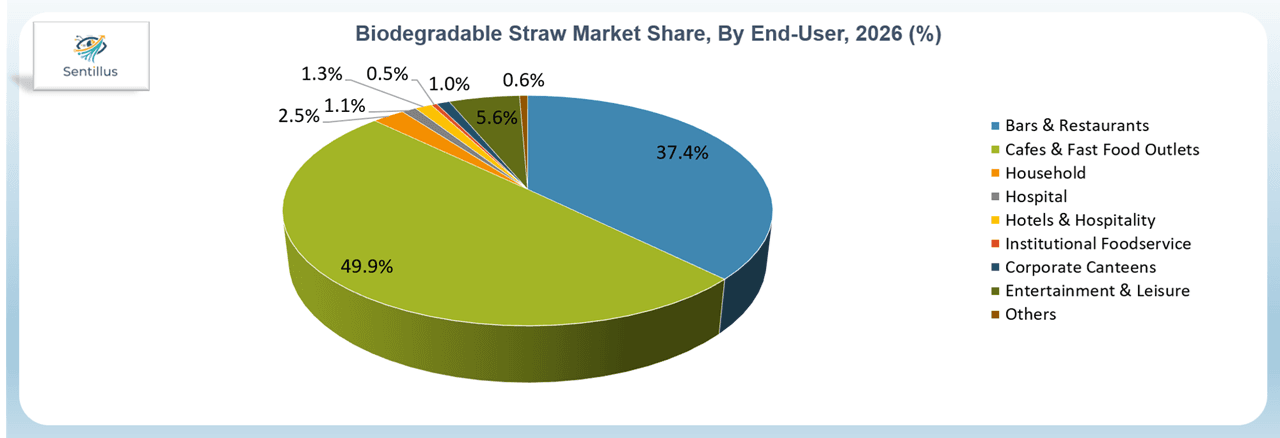
Cafes and fast-food outlets represent the largest biodegradable straw end-user with estimated consumption value of USD 5.3 billion during 2026, increasing to USD 103.02 billion by 2035 at a CAGR of 38.9%. The Cafe and QSR possesses several characteristics that make it particularly important for suppliers including high beverage throughput, centralized procurement, standardized product specifications and the ability of major chains to change materials simultaneously across thousands of outlets.
Restaurant-industry scale provides independent support for the underlying consumption opportunity. The U.S. National Restaurant Association projects USD 1.55 trillion of restaurant sales during 2026. Indian foodservice provides another high-growth demand base. As per NRAI industry evaluation report for 2024, the value of the foodservice sector in India stood at about Rs. 5,69,000 crore while the sector is estimated to increase towards Rs. 7,76,000 crore by 2028.
It is important since procurement choices lead to fast material transitions. A QSR chain which decides to switch from traditional polypropylene to paper or biopolymer straws would have recurring demand each time the beverage service takes place and not merely one-time purchase of equipment. Therefore, future competition will be based upon specifications of the foodservice industry such as Resistance Time, Diameter Uniformity, Wrapped & Unwrapped, Printing & Food-contact & Unit Economics. Material producers unable to satisfy high-speed dispensing and beverage-performance requirements may struggle despite possessing strong environmental credentials.
Geographical Landscape
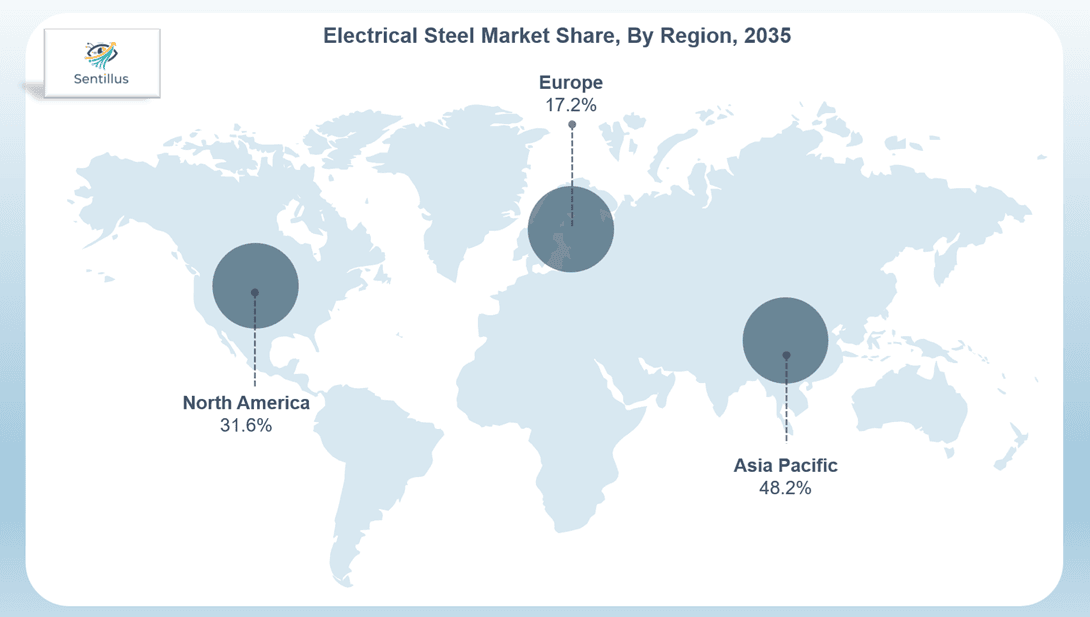
- North America dominates current consumption while Asia-Pacific provides the strongest growth trajectory.
- European demand is more regulation-driven while material definitions are comparatively stringent.
- Emerging regions remain sensitive to unit price and local enforcement.
- China provides scale through its large foodservice and beverage ecosystem while India combines rapid organized-foodservice development with a national prohibition covering plastic straws.
- Japan presents a more mature consumption environment where quality and functionality carry greater weight. Australia is shaped by state-level restrictions rather than one uniform national straw ban.
- Country growth therefore cannot be explained simply through population.
- Foodservice transaction intensity, QSR penetration, regulation, enforcement, material availability and customer willingness to absorb higher unit costs determine biodegradable straw consumption more directly.
United States Biodegradable Straws Market Analysis
United States represents the largest market with Sentillus estimating consumption value at USD 7.24 billion in 2026, increasing to USD 142 billion by 2035 at a CAGR of 39.2%. Foodservice scale provides the strongest independent demand foundation. Restaurant industry sales are projected to reach USD 1.55 trillion during 2026 which creates an enormous addressable pool of beverage transactions requiring straws or alternative drinking systems.
Regulatory conditions have become less predictable. Executive Order 14208 of February 2025 directed federal agencies to eliminate paper-straw procurement and reversed federal procurement preferences disfavoring plastic straws. State and local policies remain separate which creates a fragmented compliance environment rather than a complete nationwide reversal of alternative-straw demand.
Commercial implications may favour material diversification. Paper suppliers face greater political and performance scrutiny while PHA and other alternatives can compete where customers want plastic-like functionality without returning completely to conventional polypropylene. Major restaurant chains also make procurement decisions according to corporate packaging strategies which can continue independently of federal purchasing policy. In US, suppliers offering several material platforms should be better positioned than companies dependent entirely on paper.
Japan Biodegradable Straws Market Landscape
Japan represents a comparatively mature Asian market with consumption value estimated at USD 110.96 million during 2026, reaching USD 1.22 billion by 2035 at a CAGR of 30.6%. Growth remains below China and India because Japan already possesses sophisticated packaging practices while foodservice expansion is less dependent on rapid outlet additions.
Product quality should exert greater influence on Japanese adoption than simple regulatory substitution. Consumers and foodservice operators require consistent drinking performance while beverage packaging frequently integrates straws into highly standardized formats. Paper products therefore compete not merely against conventional plastic but against strawless lids and other packaging redesigns.
Japan also possesses significant paper and materials engineering capability which creates opportunities for technically improved fibre-based products. Domestic packaging companies can integrate straw development with broader cup, carton and foodservice packaging systems rather than treating straws as isolated components.
Premium paper products, coated fibre solutions and advanced biodegradable polymers can gain where suppliers demonstrate beverage compatibility and reliable quality. Price competition should remain important although Japan’s comparatively mature packaging sector creates room for technically differentiated products.
India Biodegradable Straws Market Outlook
India represents the fastest-growing market with consumption value increasing from USD 218.95 million in 2026 to USD 8.2 billion by 2035 at a CAGR of 49.6%. Regulatory intervention provides a direct substitution mechanism because the Plastic Waste Management Amendment Rules prohibit identified single-use plastic items including plastic straws. The prohibition covering manufacture, import, stocking, distribution, sale and use became effective from July 1, 2022.
NRAI’s India Food Services Report 2024 valued the foodservice at approximately INR 5.69 lakh crore and projected growth toward INR 7.76 lakh crore by 2028. Organized foodservice was projected to grow faster than the overall sector which is particularly relevant because organized chains generally apply standardized packaging procurement across outlets.
Paper currently offers the most accessible replacement route although India’s agricultural resource base creates opportunities for bamboo, hay and other fibre products. PLA and PHA could gain over time where regulatory interpretation and end-of-life infrastructure support their use.
Domestic manufacturing economics should become increasingly important because high-volume QSR operators require low unit costs. Supply chain players with the ability to source the fibre locally and automate the high speed production process are able to gain considerable market share from the expansion of organized foodservice.
Competitive Landscape
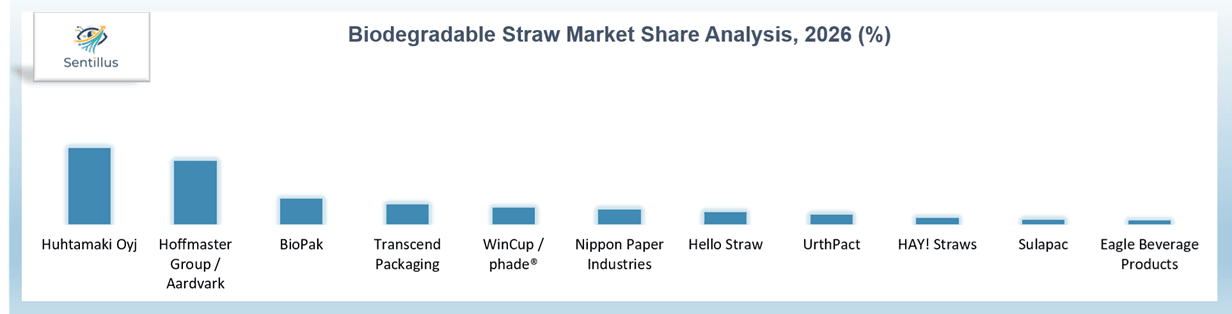
The competition in the space of biodegradable straws is highly fragmented as different players have different levels of expertise in terms of technology. Large packaging suppliers benefit from existing foodservice customer relationships while specialized companies compete through novel materials and sustainability credentials.
Paper remains commercially mature while PHA represents a technology-development battleground. The production capacity for bioplastics is expected to almost double between 2025 and 2030. It will be beneficial in making resins available to converters. Leadership in the future will not only rest on providing a product that is biodegradable but must focus on giving proven performance in specific discard conditions.
Market competition for biodegradable straws globally is increasingly focusing away from simple paper alternatives and towards material performance, compostability certifications, foodservice relationships, and large-scale manufacturing capabilities. Major packaging firms have advantage due to their well-established purchasing connections whereas PHA, compostable material-based and natural straw manufacturers will differentiate through product features and enhanced drinking performance.
- Huhtamäki Oyj: Huhtamaki concentrates on scalability in paper straw offerings combined with the wider foodservice packaging product range utilizing certified fibre sourcing as well as variety of straw products catering to international QSR, beverages, and hospitality industry customers.
- WinCup/phade: WinCup’s competitive edge comes from offering phade PHA straws with performance close to plastic straws but with enhanced end-of-life properties. Expansion across cocktail, jumbo, giant and boba formats indicates a strategy of extending PHA technology across multiple beverage applications.
- Hoffmaster Group / Aardvark Straws: With their existing Aardvark brand name and foodservice distribution system in North America, Hoffmaster uses commercially compostable paper straw options of various diameters, lengths, and wraps.
- BioPak: Biodegradable straws of BioPak are offered as part of a sustainable food service packaging range including cups, lids, utensils, and disposable takeaways. Large scale manufacturing and packaged sourcing of paper straws allow for entry into cafes, restaurants, and institutions.
- Transcend Packaging: Transcend Packaging is concerned with manufacturing large quantities of paper straws in Europe, serving quick-service restaurant chains, movie theaters, and retailers from various facilities.
- Nippon Paper Industries: Nippon Paper uses its fibre and paper-engineering capabilities to improve paper straw durability, surface properties and drinking performance. Integration with upstream paper technology provides differentiation as customers demand better-performing fibre alternatives.
- Sulapac Oy: Sulapac follows a material-technology strategy through biobased and industrially compostable materials suitable for extrusion applications including straws. Partnerships with converters provide a route for expanding adoption without requiring Sulapac to compete primarily as a high-volume finished-straw producer.
- UrthPact, LLC: UrthPact focuses on certified compostable products alongside private-label and customized manufacturing for foodservice customers. Its strategy addresses brands seeking alternatives with stronger environmental positioning and tailored product specifications.
- Hello Straw: Hello Straw competes through specialized paper straw production spanning straight, flexible, bubble-tea and aseptic formats. Product customization and improved liquid resistance support expansion across beverage brands and foodservice customers.
- HAY! Straws: HAY! Straws differentiates through minimally processed wheat-stem and reed-stem drinking straws rather than converted paper or engineered polymers. Its natural-material positioning primarily targets restaurants, bars, hospitality operators and sustainability-focused foodservice customers.
- Eagle Beverage Products: Eagle Beverage Products serves specialty beverage and foodservice customers through drinking straws and related beverage accessories. Product variety and established distribution relationships support its position primarily within the North American market.
- Corn Next: Corn Next represents an emerging starch-based material competitor focused on replacing conventional plastics with biodegradable alternatives derived from renewable feedstocks. Commercial opportunity depends on scaling material technology and securing foodservice conversion partnerships.
BCG Matrix Analysis
| Quadrant | Companies | Strategic Position |
| Stars | Huhtamaki, Hoffmaster/Aardvark, WinCup/phade, BioPak | Strong foodservice access and established commercial products support market leadership while phade provides differentiated exposure to rapidly developing PHA technology. |
| Cash Cows | Transcend Packaging, Nippon Paper Industries, Hello Straw | Established paper technologies and commercial relationships provide recurring demand while innovation focuses primarily on durability, customization and manufacturing efficiency. |
| Question Marks | Sulapac, UrthPact, HAY! Straws, Corn Next | Differentiated compostable, natural and starch-based technologies provide substantial growth potential although commercial scale remains below established paper suppliers. |
| Dogs | Small undifferentiated regional paper straw converters | Commodity manufacturers with limited certification, technology differentiation and major foodservice relationships face increasing price and performance competition. |
Regulatory Landscape
| Market | Regulation / Policy | Implication for Biodegradable Straws |
| European Union | Single-Use Plastics Directive | Restricts specified single-use plastic products including straws and drives fibre-based substitution |
| United Kingdom / England | Single-use plastics restrictions | Covers biodegradable and compostable single-use plastics while retaining defined straw exemptions |
| Canada | Single-use Plastics Prohibition Regulations | Prohibits manufacture, import and sale of specified single-use plastic straws with accessibility exemptions |
| India | Plastic Waste Management Amendment Rules 2021 | Prohibits identified single-use plastic items including straws from July 2022 |
| United States Federal Government | Executive Order 14208 | Ends federal procurement and provision of paper straws which creates policy divergence from several state and local restrictions |
| Australia / New South Wales | Plastic reduction legislation | Restricts plastic single-use straws while retaining accessibility exemptions and extending restrictions to integrated straws |
Canada stated in January 2026 that it Single-use Plastics Prohibition Regulations were still in effect after the Federal Court of Appeal ruling. England’s regulations are particularly relevant because the fact that a plastic is biodegradable or compostable does not necessarily exempt it from the provisions concerning single use plastics.
Australia demonstrates similar jurisdictional complexity. New South Wales extended restrictions covering integrated single-use plastic straws attached to packaging from January 2025 while maintaining exemptions for people requiring straws because of disability or medical need.
Key Developments
- December 2025: European Bioplastics reported global biobased plastics production capacity of 2.31 million tonnes during 2025 and forecast approximately 4.69 million tonnes by 2030. PHA and PLA were identified among materials contributing to future capacity growth which strengthens the upstream supply outlook for biodegradable polymer straws.
- February 2025: The United States issued Executive Order 14208 directing federal agencies to eliminate paper-straw procurement. The policy introduced a significant countertrend within the world’s largest biodegradable straw market while potentially encouraging interest in alternatives capable of addressing paper’s perceived functionality limitations.
- January 2025: New South Wales extended its restriction to machine-integrated plastic single-use straws attached to beverage packaging. Expansion into integrated packaging demonstrates how regulation is moving beyond loose foodservice straws toward additional consumption channels.
- January 2026: Canada’s Federal Court of Appeal upheld the legal basis supporting federal Single-use Plastics Prohibition Regulations which preserved the regulatory framework restricting specified plastic straws.
Future Outlook
The biodegradable straws market will become substantially more technologically diverse through 2035. Paper will remain the principal commercial material because production infrastructure and foodservice acceptance are already established. Future paper growth will increasingly depend on improved wet strength, safer coatings and better drinking performance rather than regulatory substitution alone.
PHA represents the most important emerging material opportunity. The projected 56.7% CAGR reflects both its small initial base and expectations for substantially greater biopolymer availability. Broader bioplastics capacity expansion supports the supply-side direction although commercial adoption will require meaningful reductions in resin and conversion costs.
Asia-Pacific will become increasingly influential as India and China combine enormous foodservice demand with regulatory pressure against conventional disposable plastics. North America will remain the largest market although United States policy divergence introduces greater uncertainty around paper. Europe should continue favouring replacement solutions but regulatory definitions will require suppliers to demonstrate that products genuinely comply rather than relying on biodegradable marketing terminology.
End-of-life infrastructure will become a decisive competitive factor. A material capable of industrial composting provides limited practical advantage when collection systems cannot separate or process it. Suppliers should therefore align material selection with actual disposal pathways in each country.
Foodservice procurement will remain the industry’s commercial centre. Cafes and fast-food outlets can deploy material changes across large outlet networks while beverage innovation continues increasing the variety of cold drinks consumed outside the home. Growing specialty beverage activity can increase demand for wider diameters and longer-lasting straws which should favour materials offering greater structural performance.
Who Should Buy This Report
The report provides strategic value for biodegradable straw manufacturers, paper converters, plastic resin producers, food service packaging companies, QSR and café procurement teams, beverage manufacturers, restaurant groups, distributors, agricultural-fibre processors, compostable packaging companies, private equity investors, packaging investors, regulatory agencies and consulting organizations evaluating the transition away from conventional single-use plastic drinking straws.
Frequently Asked Questions
Why Choose Sentillus?
Decision-Oriented Research
Sentillus delivers research designed for business decisions rather than information collection. Every study combines industry expertise, strategic analysis and practical market intelligence supporting investment, expansion and competitive planning.
Reliable Primary and Secondary Validation
Research integrates interviews with industry participants including manufacturers/service providers, dealers/distributors/agents/3rd-party suppliers and customers/consumers, public company disclosures, government publications, trade associations, consortiums, paid databases and verified industrial databases to improve analytical reliability.
Consultant-Level Industry Analysis
Every report explains why market changes occur, how competitive dynamics evolve and which developments create future business opportunities rather than simply presenting historical information.
Customized Business Intelligence
Clients receive research tailored to strategic priorities including market entry assessment, competitive benchmarking, supplier evaluation, investment opportunity analysis, pricing assessment and technology landscape studies.
Practical Competitive Insights
Competitive evaluation extends beyond company profiles by examining manufacturing capabilities, expansion strategies, product positioning, innovation priorities and strategic partnerships influencing industry leadership.
Comprehensive Regional Coverage
Country-level analysis evaluates industrial development, manufacturing capacity, production & yield, infrastructure investment, regulatory changes, trade activity and demand outlook across major global markets.
Continuous Research Support
Consultant assistance helps clients interpret findings, clarify market developments and understand industry trends after report delivery, ensuring greater value throughout the decision-making process.
High-Quality Research Standards
Every report follows a structured research methodology emphasizing data accuracy, logical analysis, clear business communication and actionable recommendations suitable for executives, investors and strategy planning teams.